The Re-positioning of Hong Kong Maritime Hub: An Integrated Perspective Under Global Supply Chain and Artificial Intelligence Applications
ZENG Ning Affiliations & Notes
Pui Ching Middle School Macau (Coloane), Rua das Schimas, No. 252, Coloane, Macau SAR.
Correspondence: nzeng@puiching.edu.mo
This article analyses the maritime challenges for the port of Hong Kong, focusing on regional ports integration, overall performance index as well as AI applications in smart ports. Findings offer insight into container throughput, freight rates, congestion indices, and supply chain pressure metrics. The highlights of ports' operational effectiveness, collaborations and solutions draw the decision makers' attention to re-position HKP. Ultimately, the port can cope with the fast-growing global market, and seize the vast trading deals under global supply chain to remain as a major hub and gateway to connect the world.
Keywords :
Maritime Hub; Global Supply Chain; Artificial Intelligence; Triopoly
1. Introduction
For more than one and half century, Hong Kong maintains an excellent and international maritime centre as a leading position, owing to its strategic location, deep water harbour, well-developed infrastructure. Under the fast-growing global supply chain market, its role has been set to be more crucial than ever.
Since the adoption of BRI by Chinese government in 2013, Hong Kong's external trade reached HK$9,464 billion in 2024, which has increased by nearly a quarter (data released by Census and Statistics Department Hong Kong SAR). This record may reflect Hong Kong's role as a key facilitator and platform for the global supply chain, while the data of its container port throughput sends an incoherent message. Among the top 20 busiest ports, Hong Kong is one of the few to record a sharp drop during past years (Figure 1): an all-time high of 24.49 million Twenty-Foot Equivalent Units (TEUs) in 2008 and a record low of 13.69 million TEUs in 2024 (data released by United Nations Conference on Trade and Development [UNCTAD] and Census and Statistics Department Hong Kong SAR).
Figure 1. Hong Kong's Container Throughput (in million TEUs) and Ranking (Source: The World Bank, Lloyd's List, Census and Statistics Department of Hong Kong)
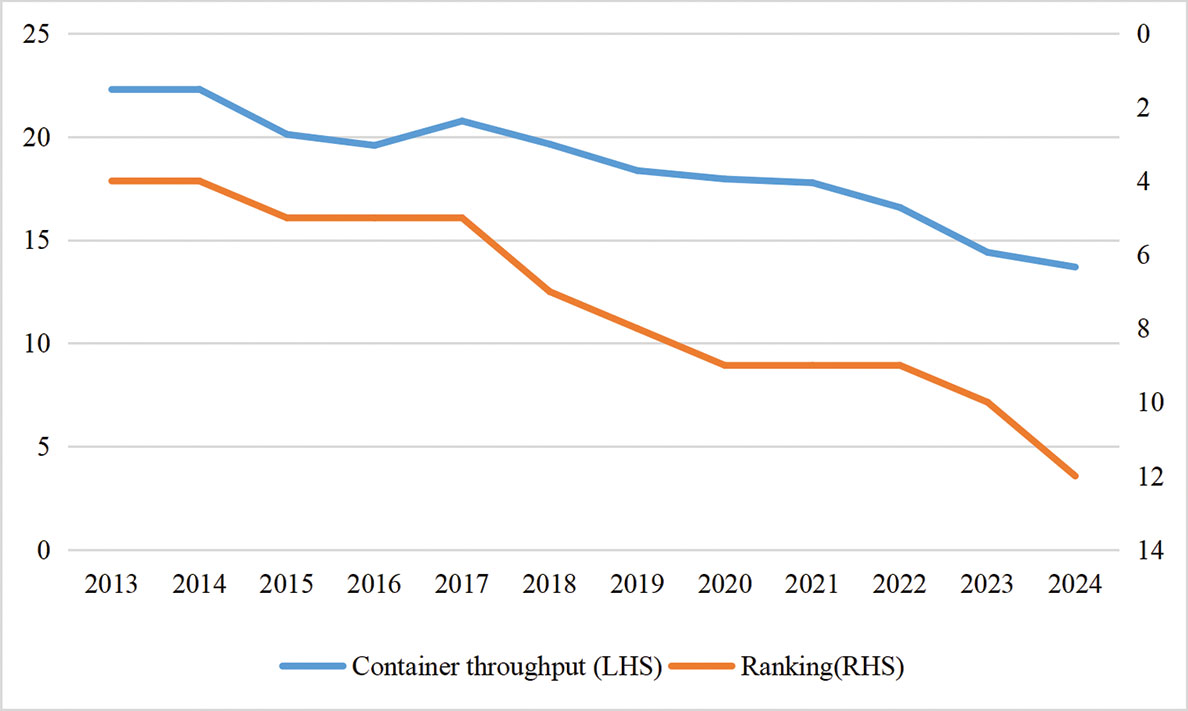
LHS is left-hand scale and RHS is right-hand scale.
As an indicator of global trade performance, container throughput—the number of TEUs handled by a terminal annually—is a fundamental driver of economic growth. Container ports with high throughput are not only logistical giants but also key nodes in the supply chain, which affect transit time, shipping costs, as well as environmental impact and thus play an essential role in global competitiveness.
This article analyses the maritime challenges for the port of Hong Kong (HKP), focusing on regional ports integration, overall performance index as well as artificial intelligence (AI) applications in smart ports. Results provide insight into container throughput, freight rates, congestion indices, and supply chain pressure metrics provides. The highlights of ports' operational effectiveness, collaborations and solutions draw the decision makers' attention to re-position the port of Hong Kong, and to cope with the fast-growing global market, and to seize the vast trading deals under global supply chain to remain as a major hub and gateway to connect the world.
2. Maritime Challenges
2.1 Integration with the Greater Bay Area
For a long time, HKP was the gateway for the rest of the world to enter Chinese Mainland. As China's accession to World Trade Organization (WTO) in 2001, and the rapid development of Guangdong-Hong Kong-Macao Greater Bay Area (GBA), HKP is standing at the crossroads.
Towards the inland, GBA integrates nine major cities within the Pearl River Delta, plus two special administrative regions—Hong Kong and Macao—into a single city cluster. This mega-region contributes over 10 percent of China's GDP due to its multi-port system: Shenzhen (SZP), Guangzhou (GZP) and HKP (Zheng et al., 2022). Previous studies investigated the relationships among those three ports under a framework of port development model (Liu et al., 2013). Results suggested a weakened leading position for Hong Kong due to and regional policy favourable towards foreign direct investment (FDI), which is coincided with major findings in the literature (Fu et al., 2023).
Particularly, Liu et al. (2020) examined the mechanism of port competition between HKP and SZP through Edgeworth model and Stackelberg leadership model, and proposed a "Seaport Alliance" for both benefits. In fact, the Alliance should add Guangzhou in as a triopoly Bertrand–Edgeworth model, and apply the core concepts—capacity constraints, price competition, and consumer rationing—to international container markets on prices and volume to maximize profits.
Assumption 1. SZP, GZP and HKP produce a homogeneous good at the same constant unit cost, up to capacity. The total market capacity is defined as:
\begin{equation} C = C_1 + C_2 + C_3 \end{equation} (1)
where \begin{equation} C_1 \ge C_2 \ge C_3 > 0 \end{equation} .
Here, \begin{equation} C_i \end{equation} denotes the maximum handling capacity of port i.
Assumption 2. The market is described by demand as a function price: D(p), and price as a function of quantity: P(x), where p and x are denoted as price and quantity respectively.
Assumption 3. Any rationing must follow the efficient rule.
Suppose p* is the competitive price, which can be written as
\begin{equation} p^* = P(C) \end{equation} (2)
Given necessary and sufficient conditions for the existence of a pure strategy equilibrium, features of equilibrium can be identified and so that to achieve the equilibrium payoffs under triopoly not in duopoly, that is, the profit for SZP, GZP and HKP.
2.2 Comprehensive Performance
The annual TEU throughput is a key indicator of ports' scale and importance in global trade, as around 90% of traded goods are carried by sea. Changes in TEU throughput at major ports can reflect trends in global trade and economic situation, therefore the significance of ports to the global economy is critical.
Nonetheless, the Container Port Performance Index (CPPI), published by World Bank and S&P Global Market Intelligence since 2020, evaluates the efficiency of container ports based on the total time vessels spend in port from arriving to completion of their workloads. For governments, port authorities and private stakeholders, ports' overall perform related to freight rates, congestion indices, and supply chain pressure metrics, provides essential information of port efficiency and resilience, as a result decisions and strategies can be made swiftly to enhance operational effectiveness and stimulate economic growth ultimately.
Table 1. Selected Ports Ranking by CPPI and TEUs in 2024 (Source: World Bank and S&P Global Market Intelligence, Lloyd's List)
|
Port |
CPPI |
TEUs |
|---|---|---|
|
Shanghai* |
1 |
1 |
|
Singapore |
29 |
2 |
|
Guangzhou |
8 |
6 |
|
Shenzhen** |
9 |
4 |
|
Hong Kong |
12 |
12 |
*CPPI ranking is for Yangshan.
**CPPI ranking is for Chiwan.
The global rankings by CPPI and TEUs of ports—alliance or competitors—for HKP are listed in table 1. Shanghai's Yangshan had the best performance in 2024 (same as 2022 and 2023), and stayed at top 1 in Lloyd's List as the busiest port. Three GBA ports came in closely while a huge difference for Singapore, implying that the ports handling the biggest volumes are not necessarily the most efficient and performing ones.
With lower rankings, ports may often face challenges related to infrastructure and operational inefficiencies, which is in need of potential improvement. For instance, Tuas Port of Singapore is now being upgraded into a single, fully automated, and smart gigantic container. Upon the conclusion of the fourth phase, Tuas Port will be a resilient port capable of handling up to 65 million TEUs each year at a single consolidated location for Singapore's container activities, which will significantly increase operations efficiency.
Although HKP is ranked 12th overall in the 2020–2024 assessment and maintains a significant role despite an intensified regional competition, the government of Hong Kong launched a HK$215m injection to install a port community system in the beginning of 2025 (Hong Kong SAR Government, 2025). So that it will enhance data processing among maritime stakeholders.
2.3 Smart Ports with Integration of IoT and AI
In a survey conducted by Maersk (2024), decision makers show an expectation that over half of new port projects to be semi or fully automated in five years. Smart ports with AI, the Internet of Things (IoT), and optimisation of operations, will promote ports' safety, enhance sustainability and offer transformative solutions. Further, such innovations and technology can also help ports maximise throughput space wise and reduce operating costs considerably.
However smart ports are not merely a matter of technological upgrades, they represent a transformation of role. A smart port functions as a green logistics hub that integrates automation, AI, sustainability initiatives, emissions trading mechanisms, and even serves as a global data centre. For instance, embracing AI and IoT with minimal human input, Shanghai's Yangshan Deep Water Port—the world's largest port—operates fully automated terminals. Some of the key features include: AI-based traffic flow optimization, smart customs and quarantine inspections, and Blockchain-based bill of lading systems.
For less developed economies, they tend to be more vulnerable when confronting fast changing maritime industry. International Maritime Organization (IMO) is always in collaboration with other developed economies to provide support. In collaboration with Norway, a maritime "single window" was delivered in Antigua and Barbuda in 2019. Recently, the SWiFT project was established by IMO and Singapore in March 2021, which is one of IMO's strategic partnerships to support ports, such as the Port of Lobito in Angola, in need to facilitate in establishing secure digital interconnectivity with counterparts worldwide, since the mandatory of Maritime Single Windows (MSW) commencing in 1 January 2024 (IMO, 2021).
As an international maritime hub, Hong Kong is also a global Research & Development (R&D), banking and financial centre, with a large pool of talented professionals for AI development, supply chain management. There are relatively low taxation rates, protective of intellectual property rights, and a unique "one country, two systems", which will speak HKP as an excellent container solution provider as well, especially to those developing or undeveloped countries and territories.
3. Conclusion
This article highlights ports' operational effectiveness, collaborations and solutions in understanding the situation of Hong Kong as an international maritime hub, and hence offer insight into container throughput, freight rates, congestion indices, and supply chain pressure metrics. Findings suggest that the port of Hong Kong may seize the fast-growing global supply chain trading opportunities to be re-positioned as an AI-based smart port solution provider combined with financial and tax service, in collaboration with maritime associations and high-tech enterprises. Future research should capsulate data sets into empirical approaches such as triopoly Bertrand–Edgeworth model to capture some specifications for decision maker to enhance operational effectiveness and stimulate economic growth ultimately.
Acknowledgements
I greatly appreciate Ho Fung Jaydan Chan and Darson Kao for their constructive comments and suggestions and hence I gratefully acknowledge their contribution to the international maritime ports analysis in this article. I am grateful to referees and editors for their helpful suggestions. Also thanks are due to Chi Hong Lei for his research support for the earlier versions of this article.
- Edgeworth, F. Y. (1925). Papers Relating to Political Economy (Vol. 1). New York: Burt Franklin.
- Fu, Y., Lin, Q, Grifoll, M., Lam, J. S. L., Feng, H., (2023). Investigating the Evolution of the Guangdong-Hong Kong-Macao Greater Bay Area (GBA) Multi-port System: The Multi-faced Perspectives. Ocean & Coastal Management, 233. https://doi.org/10.1016/j.ocecoaman.2022.106450
- Hong Kong SAR Government. (2025, February 26). The 2025–26 Budget, Speech by the Financial Secretary, the Hon Paul MP Chan moving the Second Reading of the Appropriation Bill 2025. GovHK Press Release. https://www.budget.gov.hk/2025/eng/pdf/e_budget_speech_2025-26.pdf
- Liu, L., Wang, K. Y., Yip, T. L. (2013). Development of a Container Port System in Pearl River Delta: Path to Multi-gateway Ports. Journal of Transport Geography, 28: 30–38. https://doi.org/10.1016/j.jtrangeo.2012.10.002
- IMO. (2021). Call for Expressions of Interest to become a Pilot Country of the IMO-Singapore Single Window for Facilitation of Trade (SWiFT) Project. Circular Letter No.4391. London: IMO.
- Liu, Z., Yang, D., Ng, Y. N. E. (2020). A Competitive Analysis of Port of Hong Kong: from External to Internal. Journal of Shipping and Trade, 5(1): 2–17. https://doi.org/10.1186/s41072-020-00062-2
- Maersk. (2024). Logistics Trend Map Report. https://www.maersk.com/insights/logistics-trend-map/smart-ports?exit=logistics-trend-map-report
- World Bank. (2025). The Container Port Performance Index 2020 to 2024: Trends and Lessons Learned. Washington DC: World Bank.
- Zheng, M., Lian, F., Yang, Z. (2022). Study on the Transport Advantage and Optimal Port Scale of a Bay Area. Ocean & Coastal Management, 219. https://doi.org/10.1016/j.ocecoaman.2022.106056