Zero-carbon Shipping: Realities, Future Prospects, Technical Breakthroughs, and Economic Viability
Trond Hodne Affiliations & Notes
Senior Vice President, Business Director for the Maritime Business Area of DNV.
This article examines the challenges and future prospects of decarbonization in the shipping industry, with a focus on regulatory drivers, alternative fuel adoption, energy efficiency improvements, and technological innovations. International regulations are accelerating the shift toward low-carbon fuels including LNG, biofuel, methanol, ammonia and hydrogen. Energy-efficiency measures are expected to reduce fuel consumption and emissions, while verified data and standardization are crucial for compliance and commercial value. The study emphasizes that diversified fuel and technological pathways, cross-value-chain collaboration, and policy incentives are crucial for achieving IMO's net-zero goal.
Keywords :
Decarbonization; Alternative Fuels; Energy Efficiency; LNG; Methanol; Ammonia; Data Analysis
1. Introduction
Designing and operating a ship to justify its investment over the economic life is ever-more complex given current regulatory developments, the wide choice of fuel for compliance and availability of cost saving energy-efficiency technology at different maturity level. A complexity that becomes even more challenging considering the uncertainty in a developing regulatory landscape, technology with unverified performance gains and unsettled commercial elements. To speed up the decarbonization effort, ship owners need clarity for level playing field supported by international regulations with proper enforcement mechanisms, preferably combined with commercial incentives, and of course availability of compliance solutions. Shipowners, yards, and other decision-makers need insights and foresight based on deep sectoral experience, transparent quality data, robust research, and expert forecasting. Given the challenging road ahead, the industry needs all stakeholders to share business risks and sound business cases.
A level playing field based on international regulations combined with commercial incentives for shipowners are seen as the most important components to drive decarbonization. And with the key greenhouse gas emission targets in 2030 and 2040, owners are in need of unbiased technical guidance on fuels, fuels technologies, and energy-efficiency measures.
DNV's annual Maritime Forecast to 2050 and regular publications provide high-level and detailed data, analyses, modelling, case studies, and guidance on decarbonization (DNV, 2025c). DNV publishes rules, recommended practices, standards, and other guidance to assist the industry to prepare, plan, and act in the energy transition from fossil fuels to net zero in a timely manner. The aim of this effort is to assist clients to future-proof newbuilds and existing vessels by charting pathways that are technologically and economically realistic and at the same time maintains vessel competitiveness and compliance.
2. Regulatory Drivers
Regulations and policies remain the key drivers of decarbonization toward the IMO's GHG emission-reduction goals relative to levels in 2008: 20% less by 2030, 70% less by 2040, and full decarbonization by 2050. The EU's Emissions Trading System (EU ETS) and FuelEU Maritime Regulation are already affecting costs of using fossil fuels on ships, effectively forcing use of low-GHG fuels.
The next step could be IMO's proposed Net-Zero Framework (NZF), which aims to introduce a global requirement for progressively reducing GHG emissions through 2040 (IMO, 2025). The vote on its adoption, originally expected this month, has been postponed for one year. Several aspects of the framework still require clarification, and work on the accompanying guidelines continues within the IMO. Establishing a realistic set of requirements is key, particularly regarding how funds collected through non-compliance penalties will be allocated to actively support the energy transition in shipping. These funds should help first movers to bridge the gap. The reward for specific low-carbon fuels and technology will need to act as solid incentives for owners to enable their faster adoption.
As per the existing information, the NZF would apply the GHG Fuel Intensity (GFI) as a technology-neutral metric measured as Well-to-Wake GHG emissions per energy used. In-depth analysis of the proposed NZF and compliance strategies are included in the September 2025 edition of DNV's Maritime Forecast to 2050.
3. Decarbonization Strategy
The fuel transition underway will be the dominant solution. It requires all stakeholders in the whole value chain to be on board. Until the industry sufficiently scale production, compliant fuel cost will be high and energy efficiency will therefore be an important enabler to reduce consumption and thus release pressure on escalating fuel prices and reduce fuel bills.
Diversified strategies are needed as competition for limited supplies of sustainable carbon-neutral fuels creates uncertainty over availability and pricing. Consequently, enhancing energy efficiency through technological and operational measures will be an important contributor for balanced scaling of zero-/low- carbon fuels to the market. Onboard carbon capture and shore-based power at berth are additional options to support decarbonization in a practical manner.
Figure 1. Decarbonization Solutions That Can Contribute to Reducing a Ship's Energy Consumption and Emissions from Energy Ese, and their GHG reduction potentials (Graphic: DNV)
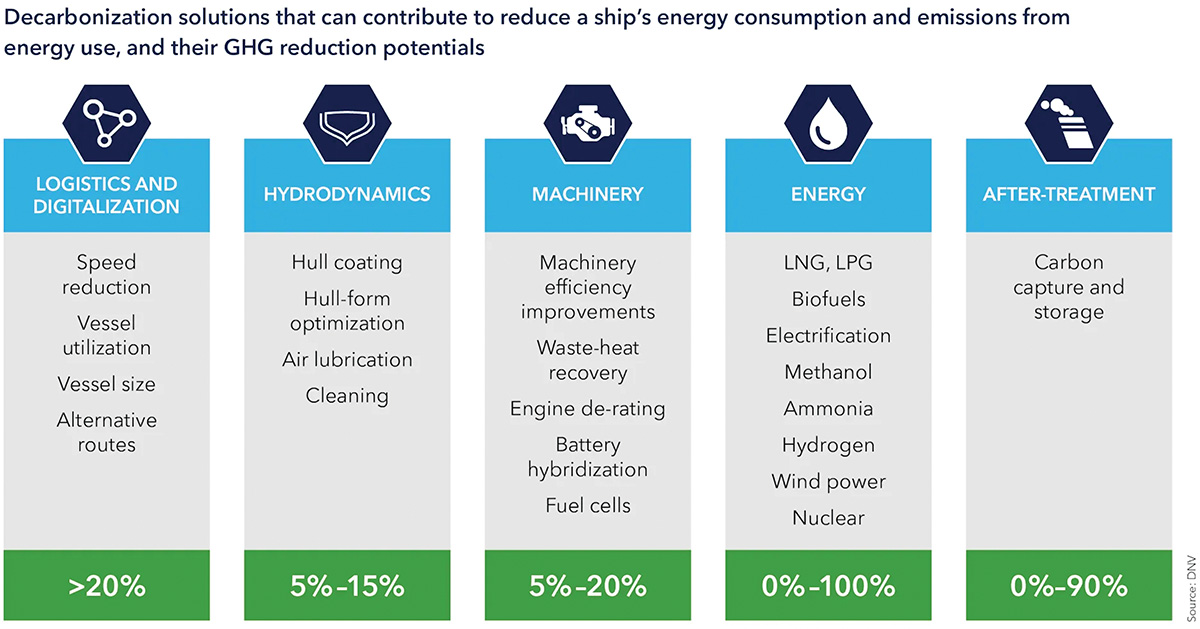
This is a pivotal moment for shipping. The early stages notably involve many fuel options such as biofuels, LNG, methanol and ammonia and hydrogen including modern sails with potential to significantly reduce fuel consumption on favourable trading routes. But evolving regulation means stakeholders must investigate all cost-effective options, individually and in combination, for the next 25 years. Successful decarbonization will require synchronized progress across ships, fuel supply, port infrastructure, and supported by investment, regulatory clarity, and industry-wide collaboration.
3.1 Tracking the Transition
DNV's Alternative Fuels Insight (AFI) online platform tracks uptakes in alternative fuels and technologies, covering investment in ships, bunkering, and fuel production facilities. The AFI data show that LNG is the most mature technology, followed by methanol-capable vessels, and the recent few orders with ammonia. As of July 2025, and measured by gross tonnage, 39.8% of ships (>100 GT, excluding LNG carriers) currently in the order book can use fuels other than fuel oil. The share measured by number of ships (16.1%) is lower because larger ships are more frequently opting for dual-fuel solutions.
Figure 2. Growth of the Number of Ships Capable of Using Selected Alternative Fuels, excluding LNG Carriers (Source: DNV)
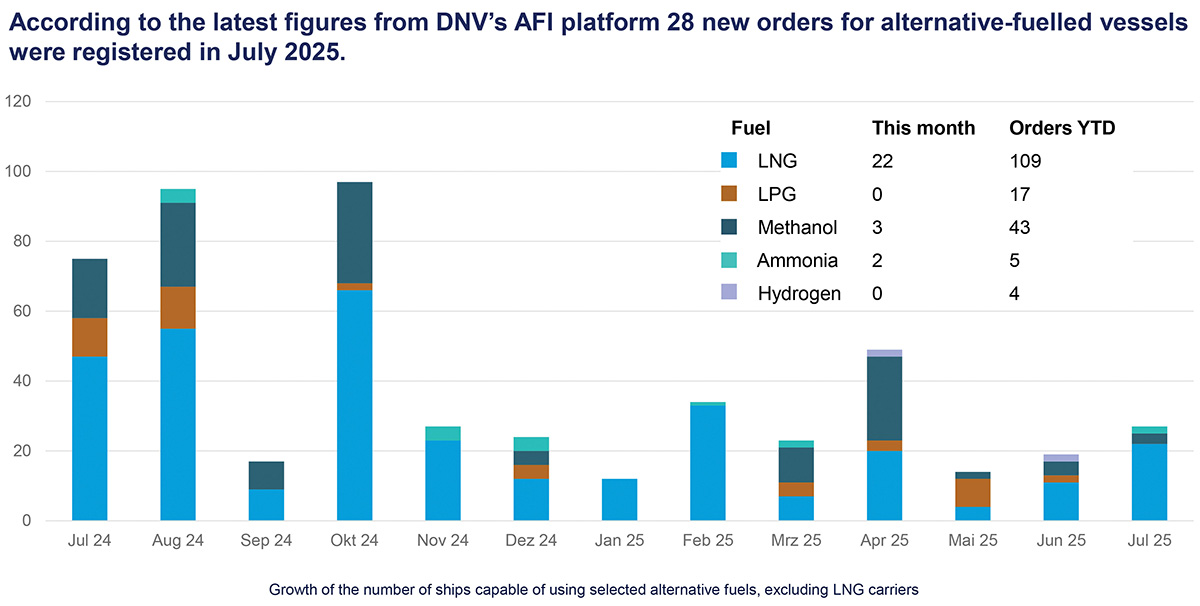
According to the latest figures from DNV's AFl platform 28 new orders for alternative-fuelled vessels were registered in July 2025.
Ordering ships that can use the new fuels has been mainly driven by commercial considerations. Regulations like EU ETS and FuelEU Maritime are not yet able to move the needle, but the IMO NZF may change that if adopted. Consequently, the AFI is not showing uniformity in alternative fuel uptake across ship segments. Containerships, cruise ships, and car carriers show relatively high uptake, mainly connected to charter requirement and a regular trading pattern.
Some say we have seen the last order of conventionally fuelled vessels for specific sizes and types of ships. But AFI finds that bulkers and tankers are relatively low on the uptake, a feature definitely connected to charter requirement. The AFI shows that the number of vessels capable of running on alternative fuels will more than double by 2028.
3.2 Alternative Fuels
The switch from conventional fossil-based fuels to low-carbon or carbon-neutral alternatives is underway despite headwinds from key barriers: technology and safety, fuel availability, demand, and cost.
Figure 3. Alternative Fuel Uptake by Ship Type | Number of Ships in Operation and on Order (Source: DNV)
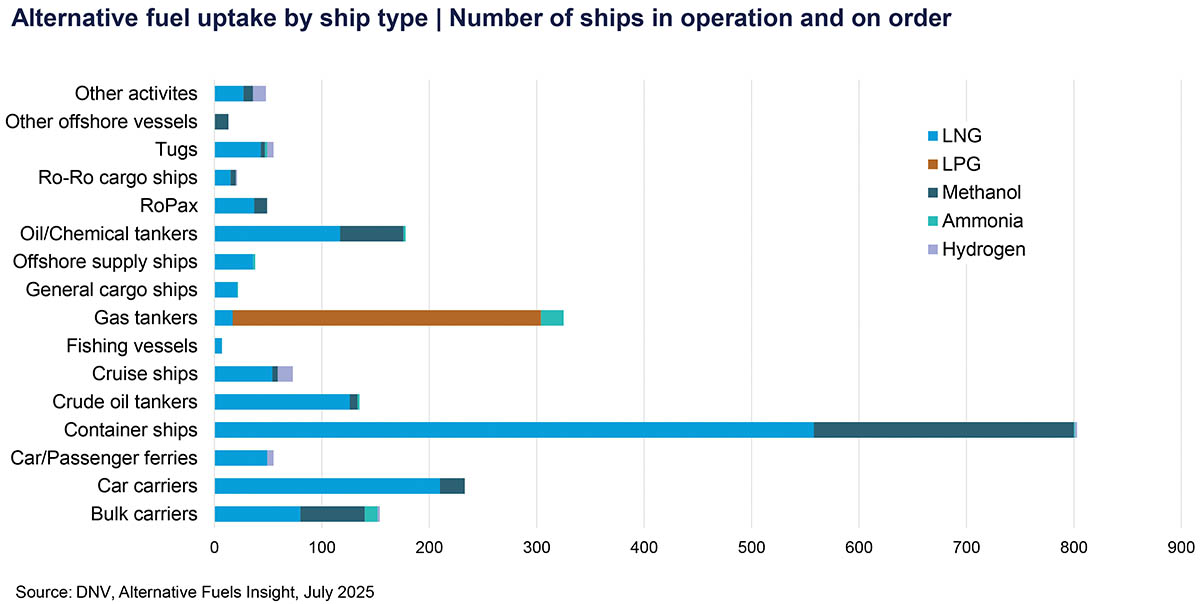
Biofuels and LNG are prominent among shipowners' choices for meeting the decarbonization targets. Followed by methanol and ammonia and later also hydrogen. DNV's analysis of the benefits is set out in Table 1 also indicating the potential impact on indexes used by the IMO and EU in regulating GHG emissions. All the studied fuels applicable to varying degrees in all vessel types included. Some ports are incentivizing uptake of low-carbon and carbon-fuels.
Table 1. Alternative, low-carbon fuels that can contribute to reduced need for conventional fuels (Source: DNV)
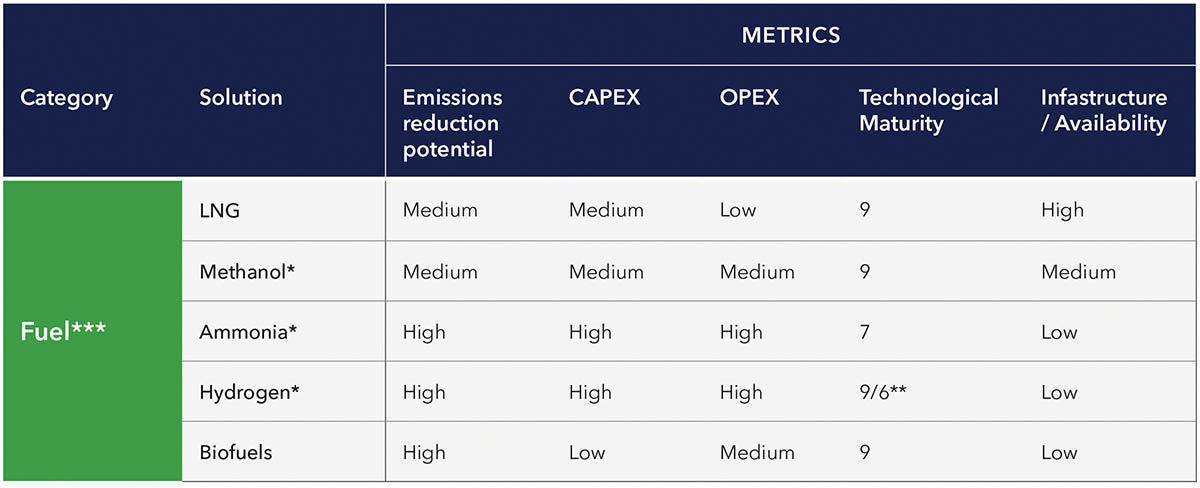
*The table values refer to the electro-, blue or bio- versions of these fuels.
**For small-scale vessels vs ocean-going cargo vessels.
***To be decided/adopted by the IMO–the assessment is based on existing proposals (MEPC 82).
3.2.1 A Role for Biofuels
Biofuel can help meet several emission standards and regulations, including the IMO's CII, the EU ETS, and FuelEU Maritime. Drop-in capability is biofuels' prominent feature. Diesel substitutes like Fatty Acid Methyl Esters (FAME) and Hydrotreated Vegetable Oils (HVO) can be used in existing engines, and bio LNG works in LNG-equipped vessels. This enables emission reductions without costly engine retrofits.
There are supply constraints: It is observed that although sustainable biofuel capacity may grow to 23 Mtoe by 2026, it will fall short of shipping's requirements, especially given competition from other decarbonizing industries. Also, and despite compatibility with current engines, biofuel properties vary and could affect engine performance. DNV's paper "Biofuels in Shipping: Current Market and Guidance on Use and Reporting" stresses careful fuel evaluation, engine-builder consultation, and crew training to avoid operational issues (DNV, 2025a).
The signs are that biofuels will play a vital but not stand alone role in shipping's decarbonization. Supply limits and logistic hurdles mean shipping must pursue multiple solutions combining biofuels with energy-efficiency strategies and preparing for other alternative fuels.
3.2.2 Liquefied Natural Gas
LNG is currently the leading alternative fuel of choice in shipping, but more regulatory clarity is needed to support its short- and long-term roles in shipping's transition strategy.
LNG offers 15% to 20% tank-to-wake CO2 emission reductions compared to conventional fuels, and also reduced NOx, SOx, and particulate matter (PM). It is a mature technology, and shipping has more than 60 years' experience in using it. LNG is widely available and has a well-developed supply infrastructure and established international safety regulations for vessel design. However, it comes with methane slip challenges for certain engine technologies, added cost and complexity due to cryogenic risks.
DNV sees a role for fossil-based LNG in providing compliance until around 2040 for FuelEU Maritime. LNG can also serve as a bridge to low-GHG fuels like bio-LNG and e-LNG, which can be burned on existing LNG-fuelled vessels. In addition, carbon-neutral methane can be used as a drop-in fuel for vessels designed with LNG capabilities, thus enabling further reduction in GHG emissions and potentially enabling carbon-neutrality.
One significant uncertainty for shipowners is that LNG's role is ambiguous within the IMO Net-Zero Framework so far. Ongoing discussions and experts work on actual Well-to-Tank (WtT) values for fossil fuels will shape how the NZF's GFI requirements will translate into targets for fossil LNG. Although the vote to adopt the NZF was postponed to 2026 work on the guidelines continues.
There is a need to resolve remaining uncertainties to ensure the framework remains technology neutral and evaluates solutions based on their GFI. The path to decarbonization is complex but achievable if we embrace both ambition and pragmatism and ensure that all options, including LNG, remain viable. Better a diamond with a flaw than a pebble without one, as a Chinese proverb puts it so elegantly.
3.2.3 Methanol
Using e-methanol and bio-methanol can build on existing distribution and storage facilities from the global network of terminals used for methanol trading and transport. Partially developed bunkering infrastructure exists at 90 ports worldwide. Demonstration of bunkering operations has been successful, and ship-to-ship bunkering proven.
Based on the methanol vessel order book, annual methanol consumption capacity has grown from an estimated 1.2 Mt (0.6 Mtoe) in 2024 to more than 8 Mt (3.8 Mtoe) in 2027. The extent to which this capacity is utilized will depend on factors such as regulations from the IMO and EU; the fuel price and well-to-wake GHG intensity of grey methanol compared with conventional fuel oils; and the price of carbon-neutral methanol compared with carbon-neutral fuel oil.
China has the largest order book for carbon-neutral methanol production, and leading Chinese shipowners are investigating its use. Carbon-neutral methanol production projects are in 25 countries, but the top 5 account for almost 70% of the total pipeline production capacity, led by China (43%) and the USA (14%). DNV estimates supply from China can increase from about 0.1 Mtpa at the start of 2025 (0.05 Mtoe/year) to 1.1–2.2 Mtpa (0.5–1.0 Mtoe/year) by 2027.
3.2.4 Ammonia
Ammonia is a promising but challenging marine fuel and DNV finds about 39 ammonia-fuel-capable vessels in current order books, observing that infrastructure and fuel supply must scale dramatically to meet IMO net-zero goals. Pilot bunkering operations, such as Fortescue's trials in Singapore, indicate progress. However, high fuel costs, limited green ammonia production, and complex bunkering procedures remain hurdles. Also, its toxicity, corrosiveness, and handling complexities demand a shift to a risk-based safety mindset. Associated additional technical barriers and human factors must be integrated early into vessel design and operations to prevent safety incidents and maintain industry confidence.
DNV's April 2025 paper "Safe Introduction of Alternative Fuels: Focus on Ammonia and Hydrogen as Ship Fuels" describes seven steps to obtain approval for ammonia- and hydrogen-fueled ships in today's immature regulatory environment by going through the IMO's alternative design approval (ADA) process (DNV, 2025d).
The paper indicates the need for broad industry engagement spanning regulators, shipowners, flag states, equipment suppliers and ammonia producers to scale up safe deployment. Safely introducing ammonia as a marine fuel is achievable if the industry adopts strict design standards, comprehensive training, a strong safety culture, ensures regulatory clarity, and fosters global cooperation. This applies not just to ammonia, and it is estimated that around 33,000 more seafarers will require additional training by 2030 to operate alternative-fuel capable newbuilds entering operation by then.
Seeing the need, DNV has collaborated with industry partners to develop the Recommended Practice (RP) DNV-RP-0699 for competence related to using ammonia fuel (DNV, 2024a) and the competence standard DNV-ST-0687 for methanol fuel (DNV, 2024b). These publications provide shipowners, operators and regulators with a structured approach to ensuring the right knowledge and skills are in place.
3.2.5 Energy efficiency
With the IMO's 2030 decarbonization goal looming, shipping needs to explore all possible GHG-reduction measures. DNV estimates that energy-efficiency improvements can yield up to 16% fuel savings by 2030, thereby lowering emissions. This equates to decarbonizing 55,000 of the smallest or 2,500 of the largest ships in the global fleet. Energy efficiency also has a vital role to play in accelerating the adoption of carbon-neutral fuels. It can ease the urgency of the fuel transition, buying time to develop markets for alternative fuels.
Efficiency makes sound business sense. Future fuels will be more expensive than today's conventional versions. So, reducing consumption will significantly improve the balance sheet. Bear in mind too that regulations like the EU ETS and FuelEU Maritime impose a premium on conventional fuels. This means that any savings in either conventional or alternative fuel translate to financial savings for shipowners. It underlines the need to include energy efficiency in any future business strategy.
The available energy-saving technologies and operational measures can be grouped broadly into five categories (see table). "Energy-efficiency Measures and Technologies" provides expert, fact-based guidance on how they can contribute to strategies for maritime decarbonization (DNV, 2025b).
Table 2. Five Categories in DNV's Energy-efficiency Measures and Technologies Report
|
What is covered in DNV's Energy-efficiency Measures and Technologies report |
|
|---|---|
|
Category |
Technology/measure |
|
Energy Harvesting |
Wind-assisted propulsion systems (WAPS); Solar photovoltaic (PV) panels |
|
Propeller & Hull |
Air lubrication system (ALS); bulbous bow retrofit; high-performance coating; high-efficiency rudder; hull and propeller cleaning; hull form optimization; hull form optimization for real sea states; energy-saving devices aft and forward of the propeller; propeller measures; windshields (and aerodynamic optimization) |
|
Energy Consumers |
Auxiliary system optimization; energy-efficient lighting system; optimization of cargo handling systems |
|
Machinery |
Batteries; electronic auto-tuning; engine de-rating; engine performance testing and tuning; exhaust-gas boiler on auxiliary engines; improved auxiliary engines load; optimized turbocharger for lower engine loads; shaft generator (power take-off/take-in); shore power ("cold ironing"); steam plant operation improvement; variable engine speed; variable frequency drives; waste heat recovery systems |
|
Operational Measures |
Autopilot adjustment and usage; deadweight/maximum draught increase; optimization of bow thruster openings; port optimization; speed optimization; trim optimization; weather routing; DP power system upgrades |
While the industry has long experience with energy-saving technologies, their uptake is not as high as expected, certainly for the most costly and advanced solutions. The DNV study shows that energy-saving technologies are found in 7.6% of the ships. Those related to the propeller are the most frequent (in 6.7% of the ships), driven by relatively high use of more established technologies such as rudder bulb, stator fin, and propeller boss cap fin. Hull-related technologies are in 2.6% of the vessels, with bow enhancement alone in 2.0%. Other hull measures require more testing to prove their benefit.
Barriers to greater uptake of advanced energy-saving technologies include, among others, investment cost and uncertainty in the claimed performance, making a business case hard to find. Sound financial offering and third-party performance verification could contribute positively. The report details how barrier significance varies for technology and vessel type. The industry is innovating rapidly on energy efficiency, but to verify real savings it needs reliable data and robust indexes—which DNV is addressing through the Vessel Technical Index (VTI) and recommended practices. Investment in energy-saving technology during newbuilding alone is not sufficient. The sailing fleet will also have to contribute and in particular the younger fleet should consider retrofit to save cost and stay commercially attractive. DNV's study using a GHG Pathway model to simulate the demand for retrofitting packages to sailing ships indicates a peak of 1,700+ ships annually subject to retrofitting.
3.4 Reaping the Wind
Wind is beginning a new chapter in its history of being harnessed to propel ships. Several pilots on wind-assisted propulsion systems (WAPS) are being tested and moving into commercial operation.
By 2025, DNV found some 50 commercial vessels with WAPS, mostly installed since 2020, and the order book indicated strong growth the years ahead. WAPS technologies included were rotor sails, 48%; suction wings, 31%; wing sails (rigid and soft), 19%; kites, 2%. Newbuilds offer better integration opportunities but retrofit is feasible for many vessels with suitable deck space and airflow. Since 2021, various vessel types, especially bulk carriers, tankers, and general cargo ships, have increasingly been built or retrofitted with WAPS. "Wind-Assisted Propulsion Systems (WAPS): How WAPS Can Help to Comply with GHG Regulations" outlines keys to building a compelling WAPS business case for differing vessel types and operational profiles (DNV, 2025e). WAPS can deliver annual fuel savings between 5% and 20 % – and in favorable conditions, even up to 30 %, as evidenced by a DNV-verified Kamsarmax bulk carrier.
WAPS installations offer a strategic advantage for meeting several regulatory frameworks, including the IMO trio of Energy Efficiency Design Index (EEDI), Energy Efficiency Existing Ship Index (EEXI), and Carbon Intensity Indicator (CII); FuelEU Maritime, which provides a Wind Reward Factor (WRF); and the EU ETS, in which lower fuel consumption reduces emissions costs. For many vessels, WAPS is a practical, regulatory-compliant, and emissions-reducing solution.
3.5 Optimizing Port Emissions
The 2024 edition of DNV's Maritime Forecast to 2050 calls for action amongst the ports for their contribution to ship de-carbonization, preparing to offer a variety of alternative fuel but also to provide incentives for front runners going green. For example, the Maritime and Port Authority of Singapore offers reductions in port dues for ships using low-carbon fuels like LNG or biofuel blends, with greater reductions for zero-carbon fuels such as hydrogen. Harbour craft using low- or zero-carbon fuels can qualify for a five-year waiver of port dues at Singapore (Maritime and Port Authority of Singapore, 2024).
When docked, ships in port consume about 7% of their annual total fuel consumption for lighting, heating, cooling, and loading/unloading operations. Shore power can significantly reduce emissions and noise in ports, whose advantages are acknowledged in some GHG regulations (e.g., FuelEU Maritime).
The Maritime Forecast 2050 (2024 edition) has compared emissions intensities of direct shore power, onboard generation by Marine Gas Oil (MGO) engines, and electrofuels like e-ammonia. This showed (a) MGO fuelled generators often produce more GHGs than the ship plugging into many national power grids through shore power, and (b) electrofuels only improve total emissions, compared to MGO, if produced from very clean electricity.
Shore power has been in commercial use since the early 2000s. DNV assigns shore power a TRL of 8 and considers it particularly but not exclusively suited to PCTCs, Ropax, cruise and containerships at newbuild stage or as a retrofit and across a wide range of vessel ages. Barriers so overcome are lack of infrastructure, adequate power capacity and standardization. There is currently no standardized voltage or connection system for shore power, though efforts are underway to establish con sistent standards.
3.6 Batteries
Shore power can also be used for charging batteries of plug-in hybrid and fully electric vessels. Battery use is mainly for short-sea shipping, for propulsion and consumers, covering from a low share to 100% of normal operation. Battery power does not preclude having diesel generators for non-normal operation such as poor weather conditions, delays, and technical issues with battery chargers on land.
"Plug-in hybrid" means batteries are charged from shore; but even if they are not, they can improve the energy efficiency of combustion engine-based power systems. Applicability of batteries for propulsion and/or auxiliary loads depends on the operational profile of vessels.
Assigning batteries a TRL of 9, DNV sees them as most applicable currently for PCTCs, Ropax, cruise ships, containerships and, to a degree, LNG and other gas carriers. Lithium-ion batteries introduce risk of thermal runaway. Safety measures such as thermal runaway propagation protection in the battery system, sufficient ventilation, and suitable fire suppression are needed.
According to DNV's AFI platform, more than 1070 battery vessels are operating worldwide, and more than 460 are on order.
3.7 Capturing Carbon on Vessels
Studies show onboard carbon capture (OCC) pre-exhaust can be applied safely, though it needs further development and optimization. Technical feasibility issues include vessel size, operational profile and trading pattern, the onboard machinery capacity for power and heat production, and the space available. Pilot projects are filling knowledge gaps on implementation.
DNV assigns OCC a TRL of 7. Based on past DNV projects and available industry data, cost estimates are: CAPEX of USD 1–15 million per OCC installation; CO2 reduction potential of 10% to 40%; 20% to 40% greater OPEX including the fuel penalty for powering OCC and storage. Actual numbers depend on vessel specifications and technology. Efficiency gains vary by vessel type, size, conditions, and should be verified on real vessels.
OCC is emerging as a credible mid- to long-term measure, though immediate deployment is tempered by regulatory and receiving terminal uncertainties. The EU ETS is the only regulatory framework offering commercial incentives for OCC today, while the IMO has started regulatory work addressing this technology. "The Potential of Onboard Carbon Capture in Shipping" identifies the main barrier to OCC as infrastructural (DNV, 2024d). Sustainable disposal or use of captured CO2 requires a value chain with reception facilities at ports for CO2 offloading, and processes for managing and sustainable handling.
4. The Importance of Data
Verified emissions data is rapidly becoming a critical enabler in the decarbonization of shipping, serving not only to ensure compliance with evolving regulatory frameworks, but also to enhance transparency and foster trust in commercial transactions across the maritime value chain. Central to its effectiveness is the establishment of robust, globally harmonised data standards, which ensure consistency, comparability, and interoperability of emissions information across stakeholders. Together, verified data and recognised standards play a dual role: meeting regulatory obligations while unlocking commercial value through mechanisms such as emissions‑linked pricing, green financing, and cargo owner disclosure. As such, verified emissions data, underpinned by agreed data standards, stands poised to function both as a robust compliance instrument and as a powerful market differentiator in the industry's transition toward a low‑carbon future.
On top of that, data can help with the investment decision-making process. Beyond the lack of clarity from regulation and uncertainty on fuel availability the industry also faces a lack of trust in the savings claims of EE devices and measures. This is mainly caused by the great amount of innovation that provides a lot of new developments and technologies, but at the same time does not allow for trusted verification of claimed savings. Good quality data accompanied by science-based methodologies and 3rd party verification will enable knowledge building on the new technologies and specific vessels and their operations. Wide application of such analytics will shed light on the financial applicability of technology on specific vessels.
5. Strategic Planning
Considering energy-efficiency measures and fuels in short and long-term planning is complex. DNV defines four steps that can support shipowners and other stakeholders deciding what measures to implement on newbuild or sailing vessels:
- Shortlisting suitable fuel technologies and energy-efficiency packages.
- Performance assessment (e.g., reduction in energy use).
- Design implications (e.g., space and weight requirements).
- Economic assessment (e.g., additional cost, GHG abatement cost).
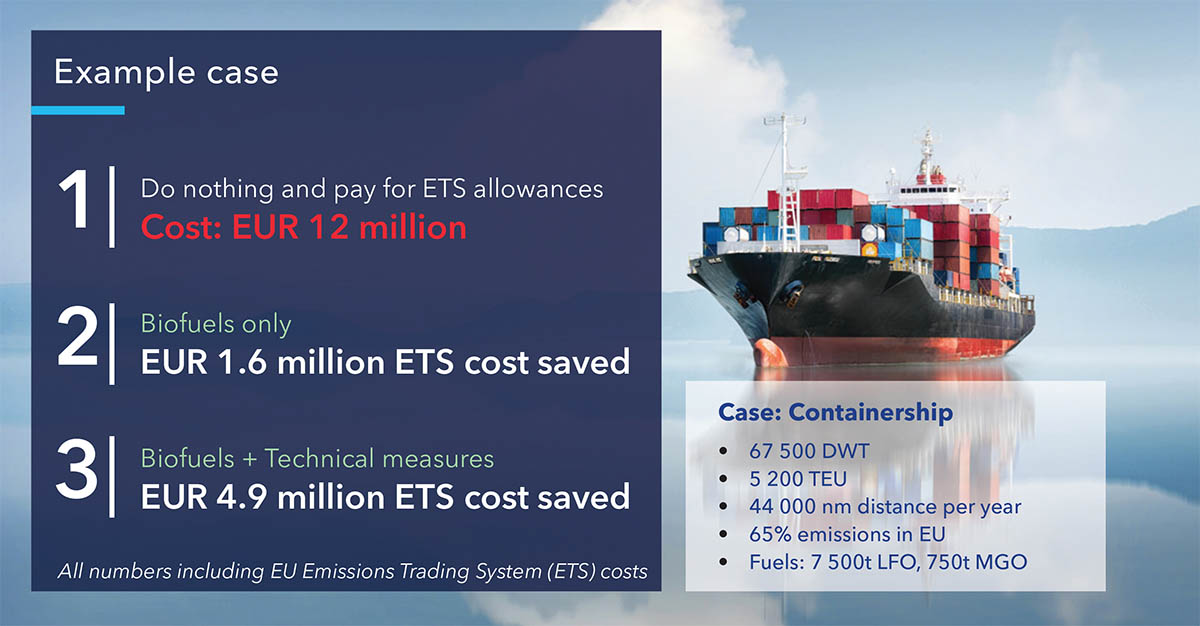
In executing these steps, different models and databases can be applied for increased accuracy. For example, the case study summarized below shows savings over a 10-year period (2023 to 2032) by introducing either just biofuel or biofuel with energy-efficiency measures (implemented in the first year) to ensure compliance and cost efficiency (DNV, 2025b).
Figure 4. Example Case of Savings by Introducing Different Measures over a 10-year Period (2023 to 2032) (Source: DNV)
Strategies for both public and private stakeholders to collaborate to fast-track the transition are discussed in DNV's Fuel Transition Roadmap for Nordic Shipping (DNV, 2024c). It urges governments to contribute to closing the cost gap, and to set up competitive tenders for green shipping corridors, port-to-port routes where carbon-neutral ships start using carbon-neutral fuels earlier than required by existing rules and incentives.
Such actions will provide confidence for the industry to invest in zero-emission vessels and the needed fuel infrastructure. The roadmap suggests how governments can ensure their countries benefit from value creation and greater exports while playing key roles in the global fuel transition.
6. Conclusion
This is a great era of innovation and development for energy efficiency, while the industry requires adequate and accurate data, science-based methodologies and standardized performance indicators to verify the energy savings. Empirical evidence indicates that the fuel transition is on the way, but efforts should be made to ensure non-shipping stakeholders' active participation across the value chain.
Furthermore, it is too early to shut down technologies and fuels, and the industry should maintain objectivity and embrace diversified solutions. Energy efficiency serves as a critical element for assisting in the adoption of new fuels.
- DNV. (2024a). Competence Related to the Use of Ammonia as Fuel. DNV-RP-0699. Oslo: DNV.
- DNV. (2024b). Competence Related to the Use of Methanol as Fuel. DNV-ST-0687. Oslo: DNV.
- DNV. (2024c). Fuel Transition Roadmap for Nordic Shipping. Oslo: DNV.
- DNV. (2024d). The Potential of Onboard Carbon Capture in Shipping. Oslo: DNV.
- DNV. (2025a). Biofuels in Shipping: Current Market and Guidance on Use and Reporting. Oslo: DNV.
- DNV. (2025b). Energy-efficiency Measures and Technologies. Oslo: DNV.
- DNV. (2025c). Maritime Forecast to 2050. Oslo: DNV.
- DNV. (2025d). Safe Introduction of Alternative Fuels: Focus on Ammonia and Hydrogen as Ship Fuels. Oslo: DNV.
- DNV. (2025e). Wind-Assisted Propulsion Systems (WAPS): How WAPS Can Help to Comply with GHG Regulations. Oslo: DNV.
- International Maritime Organization. (2025). Draft Revised MARPOL Annex VI (IMO Net-Zero Framework). Circular Letter No. 5005. London: IMO (forthcoming).
- Maritime and Port Authority of Singapore. (2024). Maritime Singapore Green Initiative. https://www.mpa.gov.sg/maritime-singapore/sustainability/maritime-singapore-green-initiative/1000