IMO GHG Emission Regulations: Global Shipowners’ Response Strategies
ZHANG Shuang Affiliations & Notes
School of Maritime Economics and Management, Dalian Maritime University, Dalian 116026, China.
The International Maritime Organization (IMO) has intensified its regulatory framework to address greenhouse gas (GHG) emissions from international shipping by developing a package of mid-term reduction measures, known as the IMO Net-Zero Framework (NZF), presenting unprecedented challenges to shipowners worldwide. This article examines how these new regulations reshape compliance costs, analyzes the differentiated strategies adopted by Asian and European shipowners, and proposes strategic recommendations for shipowners navigating this complex regulatory environment.
Keywords :
Net-Zero Framework; Greenhouse Gas Emissions; Decarbonization Strategies; Shipowners; Low-carbon Fuel
1. IMO Net-Zero Framework: From Strategy to Implementation
The international shipping sector, responsible for nearly 3% of global greenhouse gas (GHG) emissions, is under intensifying pressure to decarbonize. In its 2023 Strategy on Reduction of GHG Emissions from Ships, the IMO committed to net-zero GHG emissions by or around, i.e., close to 2050, with indicative checkpoints of at least 20% reduction by 2030 and 70% by 2040 versus 2008 levels. The strategy also calls for zero and/or near-zero GHG emission technologies, fuels, and/or energy sources (ZNZs) to represent at least 5% of the energy used by international shipping by 2030. Building on earlier efficiency and carbon-intensity measures, the IMO has now introduced its most transformative step: the Net-Zero Framework (NZF) (IMO, 2025).
1.1 Core Structure of the NZF
Approved in draft form in April 2025 and scheduled for approval in October 2025, the NZF is designed to operationalize the 2023 GHG Strategy through binding technical and economic measures (IMO, 2023). It is expected to enter into force in 2027 and take effect from 2028, covering nearly all ships of 5,000 GT and above engaged in international shipping.
The framework is built upon two main categories of measures:
- Technical Measures: Ships must reduce the lifecycle (Well-to-Wake) GHG intensity of their fuels, benchmarked against a Global Fuel Intensity (GFI) indicator. This technology-neutral metric (gCO₂eq/MJ) evaluates annual average fuel performance, with sustainability safeguards applied.
- Economic Measures: Ships failing to meet GFI targets face compliance deficits, settled through Surplus Units (SUs) trading or by purchasing Remediation Units (RUs) from the IMO Net-Zero Fund, depending on the deficit type. Ships that meet stricter Direct Compliance Targets with ZNZs receive additional rewards.
1.2 Targets, Compliance Approaches, and ZNZ Incentives
In line with the 2023 Strategy, the NZF establishes two GFI performance thresholds: a Base Target and a stricter Direct Compliance Target, with the latter set 13 percentage points lower. From 2028 to 2035, the Base Target tightens from 4% to 30% below the 2008 baseline of 93.3 gCO₂eq/MJ. The 2040 Base Target is fixed at a 65% reduction, with intermediate 2036–2040 values to be determined by 1 January 2032. Until 2030, the IMO's Base Targets are broadly aligned with the EU FuelEU Maritime standard, but from 2031 onwards they become significantly more stringent.
Annual compliance outcomes include:
- Exceeding Direct Compliance Target: Ship generates tradeable/bankable SUs, with additional rewards for ZNZ uptake, defined on a well-to-wake basis with thresholds of 0 gCO₂eq/MJ until 2034 and 14.0 gCO₂eq/MJ from 2035.
- Meeting Base but not Direct Compliance Target: Ship incurs a Tier 1 compliance deficit, which must be settled through the purchase of Tier 1 RUs from the IMO Net-Zero Fund at USD 100/tCO₂
- Falling short of Base Target: Ship incurs both Tier 1 and Tier 2 deficits. Tier 1 deficits must be balanced by Tier 1 RUs, while Tier 2 deficits can be met by acquiring SUs or purchasing Tier 2 RUs priced at USD 380/tCO₂
1.3 Other Key Elements
To ensure the effective implementation of the NZF, IMO will establish three supporting pillars, complementing the traditional "ship/flag State/port State" compliance system. First, the Global GFI Registry will record verified ship performance, track the transfer of Surplus Units, and document the settlement of compliance deficits. Second, the IMO Net-Zero Fund will function both as a compliance settlement facility and as a financing vehicle for the sector's transition. Its revenues—primarily from the purchase of Remediation Units—will be allocated to reward the uptake of ZNZs and to support just and equitable transition within the boundaries of the energy transition in shipping. Third, the Sustainability Framework embeds lifecycle safeguards by requiring well-to-wake accounting and independent certification of marine fuels against sustainability criteria. Together, these mechanisms form the institutional backbone that transforms targets into enforceable and equitable outcomes.
2. Impact on Compliance Costs for Global Shipowners
This section examines the NZF's impact on compliance costs for shipowners, focusing on fuel costs and associated compliance payments or revenues. Broader factors—such as capital expenditure, infrastructure, and global fuel availability—are excluded here, though they remain critical in real-world compliance planning (Zhang, 2025).
2.1 Pricing Structure and Economic Logic
The NZF's GHG pricing mechanism is embedded within the fuel standard and built around three parameters:
- Tier 1 RU (USD 100/tCO₂eq): Set deliberately below the marginal cost of meeting the Direct Target, encouraging most ships to comply at the Base level while covering the gap to the Direct Target via RU purchases. This ensures stable and predictable revenues for the IMO Net-Zero Fund.
- Tier 2 RU (USD 380/tCO₂eq): Set above the cost of achieving the Base Target, creating a strong incentive to avoid falling short of the Base and anchoring the upper bound of SU market prices.
- ZNZ reward (TBD): Designed to make ZNZs cost-competitive with other low-carbon sustainable fuels while avoiding excessive windfall gains.
Together, these parameters link fuel performance directly to financial outcomes, creating differentiated cost pressures across the fleet. Within this framework, shipowners are effectively guided toward two compliance strategies:
- Base Target + Tier 1 RU Purchases Profile: Ships meet the Base Target using widely available low-carbon fuels that are less expensive than ZNZs, while bridging the gap to the Direct Compliance Target with Tier 1 RUs. Rationale: This is the least-cost pathway for most existing ships in the near- to medium-term, as the Tier 1 RU price is lower than the marginal cost of additional fuel substitution outcome: Predictable compliance costs, but no revenue from surplus performance.
- Outperformance with ZNZs Profile: Ships achieve a GFI well below the Direct Target through high ZNZ uptake, generating both SUs and ZNZ rewards. Rationale: Attractive for early adopters and fleet leaders, as SU sales and rewards can offset the higher fuel costs associated with ZNZ use. Outcome: Potentially lower net fuel costs than Strategy 1, but with higher upfront expenses and exposure to fuel availability constraints.
2.2 Case Illustration
To illustrate, a dual-fuel ship in 2030 is modelled under the NZF two-tiered targets: the Base GFI target is 85.8 gCO₂eq/MJ and the Direct Compliance Target is 73.7 gCO₂eq/MJ. For easy reference, fuels in this study are labelled as follows, with values shown as GHG intensity (gCO₂eq/MJ) and price (USD/GJ):
- F fuel (conventional fossil fuel oil, e.g., MDO): 95 gCO₂eq/MJ, USD 14.0/GJ.
- B fuel (low-carbon biofuel, e.g., HVO): 30 gCO₂eq/MJ, USD 31.5/GJ.
- Z fuel (ZNZ option, e.g., green methanol meeting sustainability standards): 19 gCO₂eq/MJ, USD 54.3/GJ.
The baseline scenario assumes full use of F fuel, against which two strategies are examined: F+B blending and F+Z substitution. The ZNZ reward is assumed at a uniform fixed rate of USD 347/tCO₂eq.
Figure 1. Final fuel cost under different B/Z substitution levels (2030).
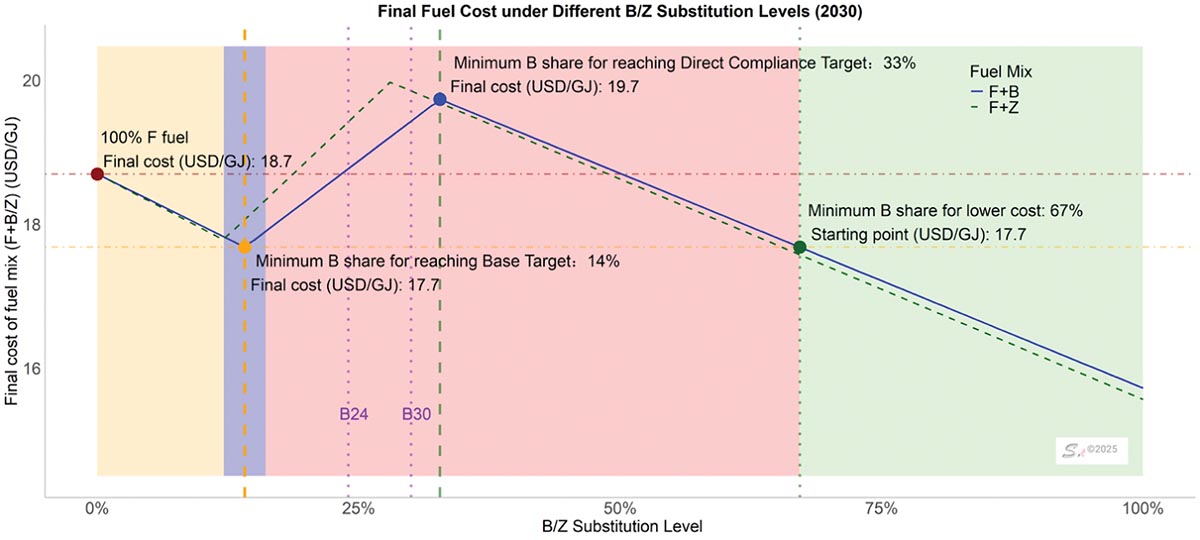
The curves illustrate the hidden cost trap between the Base and Direct Compliance Targets.
Figure 1 illustrates the resulting cost-performance curves. Under the F+B blending strategy (blue curve), compliance costs evolve in distinct phases as the share of B fuel increases:
- No action: With 100% F fuel, both Tier 1 and Tier 2 RUs must be purchased, pushing costs up to USD 18.7/GJ.
- Towards Base Target: Partial substitution reduces costs to around USD 17.7/GJ, as abatement remains cheaper than Tier 2 RUs.
- Near Direct Target: Costs rise again, reaching USD 19.7/GJ, since abatement exceeds Tier 1 RU prices while no SUs are generated.
- Beyond Direct Target (~67% B): Further substitution generates SUs, offsetting fuel costs and returning economics to Base-level.
- Full substitution: At 100% B fuel, costs decline further to about USD 15.6/GJ.
This dynamic creates a "compliance black hole" between the Base and Direct Targets — a cost-effectiveness gap where incremental improvements are swallowed without generating SUs, consuming resources without delivering compliance value. In practice, biofuel blends (e.g. B24 or B30) are typically used only to meet the Base Target, rarely extending further due to supply limits and weak incentives. By contrast, ZNZ fuels are more suitable for high-percentage substitution. With adequate rewards, ships adopting ZNZ fuels can surpass the Direct Target, generating both SUs and incentive payments, thereby turning large-scale substitution into an economically viable strategy.
2.3 Strategic Implications
The modelling highlights several critical insights with direct implications for shipowners:
- Economic sweet spots: For ships running mainly on fossil fuels, the most cost-effective strategy is typically to reach the Base Target rather than paying for full compliance or pushing toward intermediate levels near the Direct Compliance Target.
- The "compliance black hole": Between the Base and Direct Compliance Target lies a cost-effectiveness gap.
- The role of ZNZ rewards: Properly calibrated rewards are crucial to make ZNZ pathways competitive with other alternative fuels. Strong incentives can shift investment toward deeper substitution, enabling more ships to operate in the high-performance zone where SUs and rewards offset fuel costs.
- Fleet-level strategy: Not all ships should follow the same compliance path. Operators are best positioned by balancing near-term, low-cost compliance for most of their fleet with selective investment in high-performance ZNZ ships (newbuilds or retrofits) that can generate SUs and ZNZ rewards.
- Managing uncertainty: Fuel price volatility, lifecycle GHG accounting, sustainability certification, and the eventual ZNZ reward design all introduce uncertainty. Robust strategies will require flexibility to adapt to these evolving factors.
In conclusion, the NZF's cost impact is shaped not only by technical fuel performance but also by the interaction of target thresholds, RU prices, and ZNZ rewards. Optimal strategies will depend on the ability to read these signals accurately, combining short-term cost minimization with long-term positioning for the sector's decarbonization.
3. Differentiated Decarbonization Strategies among Shipowners
Although international shipping is inherently global in scope, shipowners' responses to the IMO's reinforced greenhouse gas reduction targets have not converged toward a uniform trajectory. The diversity of approaches is shaped not only by regulatory environments but also by financing ecosystems, operational geographies, and customer expectations. Against this backdrop, the pathways toward decarbonization display significant variation, with companies adopting distinct logics and priorities in the pace of investment, the choice of fuel pathways, and the management of associated risks.
3.1 Representative Strategic Categories
The practices of leading shipowners can broadly be grouped into several categories.
The first comprises early and integrated movers, predominantly among European liner operators. Maersk was among the first to order methanol dual-fuel ships, while simultaneously securing long-term fuel supply agreements to facilitate the commercialization of green methanol on deep-sea routes. This group emphasizes early positioning, integrating fleet renewal, fuel assurance, and customer partnerships to establish a competitive edge ahead of tightening regulatory cycles. Belgium's CMB. Tech, in a similar vein, has defined ammonia and hydrogen as its core fuel pathways while concurrently investing in ship design, engine development, and port infrastructure, advancing a "technology–fuel–infrastructure" integrated solution.
The second category consists of phased and multi-track explorers, most visible among Asian shipowners, who prioritize phased deployment and flexibility amid technological and market uncertainty. COSCO Shipping, for example, has expanded rapidly in methanol dual-fuel orders, now approaching the scale of leading European liners, spanning container ships, Aframax tankers, and very large ore carriers, while also cooperating with Fortescue to advance green ammonia. Japan's MOL has combined wind-assist technologies with LNG and ammonia pilots, reflecting a hybrid path that balances efficiency and fuel pathway exploration. China Merchants Energy Shipping (CMES) has introduced methanol dual-fuel solutions into its tanker and dry bulk segments while also testing wind-assist and onboard carbon capture systems, seeking to accumulate operational experience across diverse ship types.
The third group can be described as efficiency-first and technology validators, common among bulk carriers and charterers. Germany's Oldendorff has pursued digital optimization, rotor sails, and biofuel trials to deliver immediate emission reductions, while Cargill, as a major charterer, has deployed wind-assist solutions alongside biofuels to generate measurable gains for its clients. These companies adopt an "efficiency first, fuel later" philosophy—achieving intensity reductions at low cost and risk, while keeping future fuel pathways open.
3.2 Key Influencing Factors
The formation of these strategies is typically the result of multiple overlapping drivers. A first and decisive factor is policy exposure and cost pressures. European carriers, with higher exposure to intra-European and Europe-related trades, are directly subject to the EU ETS and FuelEU Maritime regulations (European Commission, 2023). Carbon costs have thus become a material financial liability, motivating them to secure fuel pathways early in the 2020s. By contrast, many Asian shipowners—particularly those with limited exposure to European trades—face comparatively looser regulatory environments, aligning their timelines more closely with IMO and national climate targets, and thereby progressing at a more measured pace.
Second, financing and customer ecosystems shape strategic choices. European companies are under closer scrutiny from ESG-focused capital markets, while major customers—especially in consumer goods and retail—demand clear decarbonization trajectories for logistics. This has compelled companies like Maersk and Hapag-Lloyd to move early. Asian shipowners, by contrast, rely more heavily on domestic banking and policy-linked financing, facing less immediate pressure from investors, while customer requirements for decarbonization remain less uniform and binding.
A third factor lies in industrial linkages and technological conditions. Chinese and Japanese shipowners are closely tied to domestic shipbuilding and fuel industries, and their choices often mirror national industrial priorities. COSCO and CMES, for instance, are deeply engaged in nurturing domestic methanol value chains, while Japanese owners emphasize state-backed demonstrations of ammonia and wind-assist technologies.
3.3 European–Asian Contrasts in Decarbonization Strategies
At an aggregate level, European and Asian shipowners do exhibit notable contrasts. European firms tend to invest earlier and at greater scale, leveraging customer and capital market pressures as drivers of vertical integration. Asian firms, by contrast, advance more gradually, embedding their strategies within domestic industrial and shipbuilding ecosystems, thereby emphasizing phased deployment, incremental learning, and risk control.
However, these contrasts are not absolute. CMA CGM, for instance, continues to rely heavily on LNG as a transitional fuel pathway, while Maersk itself has diversified into LNG to hedge against risks associated with methanol. On the Asian side, COSCO's methanol orderbook is now approaching that of Maersk, reflecting a proactive commitment, while CMES has piloted methanol across tankers and bulkers in combination with wind-assist and carbon capture technologies. In the bulk carrier and charterer segments, meanwhile, strategies are often shaped more by business models and market positioning than by geography: Oldendorff and Cargill exemplify efficiency-led, fuel-flexible approaches irrespective of regional affiliation.
In sum, all major shipowners are engaged in balancing regulatory pressures, market expectations, and capital risks. The divergence lies less in ultimate direction than in the sequencing and portfolio composition of strategies—with regional environments influencing the pace and configuration of choices, rather than determining fundamentally different destinations.
4. Strategic Recommendations for Shipowners
The following recommendations outline a decision-making framework designed to help different types of shipowners anchor their compliance roadmaps in a more resilient and competitive position for the decade ahead.
4.1 Adopt a Combination Strategy: Balance Low-Cost Compliance with ZNZ Leaders
Shipowners need to begin with a clear view of their exposure. By assessing the fleet's baseline performance and abatement potential, they can segment ships and apply differentiated strategies. Some ships may achieve Base Targets through blends of drop-in low-carbon biofuels and efficiency measures, emphasizing cost control and stable cash flows. Others are capable of surpassing Direct Compliance Targets, generating surplus units (SUs) and ZNZ rewards, thereby positioning themselves for both compliance and strategic advantage. This layered approach reflects the variety of pathways already evident in industry practice, but translates them into a structured compliance framework.
Within this framework, fleet strategies encompass the phase-out of conventional fossil-fuel ships alongside investment choices for newbuilds. The economics of the former depend mainly on the price and availability of drop-in biofuels and the Tier-2 RU prices, while Onboard Carbon Capture and Storage (OCCS) is unlikely to have a material impact before 2035. For newbuilds, investment decisions need to look beyond standard factors such as technological readiness, payback periods, and infrastructure. A crucial distinction is that each fuel type encompasses multiple production pathways. These pathways differ in abatement potential, cost trajectories, and availability. This shifts the focus from simply assessing shipboard emissions to evaluating the full spectrum of fuel pathways. For example, LNG includes fossil gas, biomethane, synthetic methane, and potential OCCS integration. Such evaluation supports long-term planning and mitigates risks of stranded assets or supply constraints.
4.2 Secure Steady Compliance: Control Fuel and Credit Risks
The variety of compliance routes also underscores the importance of disciplined execution. On the fuel side, cost stability can be supported through offtake agreements with ports or suppliers, complemented by forward contracts or other hedging tools. On the credit side, structured SU asset management is essential: setting caps on net positions and mitigating downside risks through offtake arrangements that incorporate collar-type mechanisms with counterparties.
To stay adaptive, quarterly dashboards can track compliance fuel costs (USD/GJ), SU positions, and progress toward Base/Direct targets. These indicators provide the basis for timely adjustments in fleet fuel portfolios, low- and zero-carbon fuel use, and SU holdings—helping shipowners combine stability with strategic flexibility.
4.3 Collaborate Across the Ecosystem: Align Supply, Demand, Capital, and Policy
The shipping transition will ultimately depend on more than fleet-level choices. Ports and fuel suppliers can expand green corridors and infrastructure to ensure fuel availability and price stability, backed by long-term contracts. Charterers and cargo owners can provide demand stability via green freight rates, multi-year commitments, and cost-sharing mechanisms. Financial and insurance institutions, through green bonds, sustainability-linked loans, and insurance products, can lower capital costs and hedge against market and policy risks. Policymakers and industry bodies must deliver transparent and predictable rules, reducing fragmentation and compliance duplication, and thereby amplifying the value of early action.
Ultimately, it is this alignment of supply, demand, capital, and policy that will provide shipowners with the certainty and competitive edge needed to accelerate the green transition.
5. Conclusion
For shipowners, progressing toward net-zero requires strategies that balance near-term compliance with long-term positioning. Efficiency measures and low-carbon fuel blends remain essential for cost control, while selective investment in ships and fuel pathways with the potential to meet zero- or near-zero targets provides a foundation for sustained competitiveness. A diversified portfolio that combines stability with targeted leadership offers resilience under regulatory and market uncertainty.
Yet the transition of shipping cannot rest on shipowners alone. Coordinated action across the value chain is indispensable: ports and fuel suppliers need to expand infrastructure and secure reliable supply; charterers and cargo owners can provide demand stability through long-term commitments; financial and insurance institutions play a critical role in lowering capital costs and mitigating risks.
At the policy level, the IMO's Net-Zero Framework should serve as the core anchor, supported by coherent regional and national policies. A unified global framework—rather than fragmented unilateral mechanisms—will be essential to channel investment, accelerate deployment, and ensure that shipping's decarbonization strengthens both competitiveness and climate ambition.
- European Commission. (2023). Regulation (EU) 2023/1805. Official Journal of the European Union. L234: 48–100. https://eur-lex.europa.eu/legal-content/EN/TXT/PDF/?uri=CELEX:32023R1805
- International Maritime Organization. (2021). Fourth IMO Greenhouse Gas Study 2020. London: IMO.
- International Maritime Organization. (2023). Resolution MEPC.377(80) 2023 IMO Strategy on Reduction of GHG Emissions from Ships. London: IMO.
- International Maritime Organization. (2025). Draft Revised MARPOL Annex VI (IMO Net-Zero Framework). Circular Letter No. 5005. London: IMO (forthcoming).
- Zhang, S. (2025). Overview of the IMO Net-Zero Framework. Dalian: Dalian Maritime University.