Decarbonisation and Digitalisation for Marine Engine Operation: A Perspective
XING Zhihao, Rodolfo S.M. Freitas, JIANG Xi Affiliations & Notes
School of Engineering and Materials Science, Queen Mary University of London, Mile End Road, London E1 4NS, UK.
Correspondence: Professor JIANG Xi (xi.jiang@qmul.ac.uk)
Marine engines face the massive challenge of decarbonisation. The utilisation of low-carbon alternative fuels can help decarbonise maritime transportation, and the challenge of decarbonisation can be further addressed via panoramic digitalisation. This review outlines the challenges and perspectives of decarbonisation and digitalisation for sustainable marine engine operation. Based on real-time monitoring / modelling of the engine system, future marine engines should be based on low-carbon fuel utilisation with an intelligent platform that can predict and guide the engine operation. The platform will also guide condition-based maintenance of marine engines, focusing on fuel switching and engine transient operation, to minimise fuel consumption and pollutant emissions.
Keywords :
Marine Engine; Decarbonisation; Digitalisation; Digital Twin; Fuel; Low-carbon
1. Introduction
Maritime freight and passenger transportation play a key economic role and shipping accounts for over 80% of global trade internationally, but the current mode of energy utilisation in shipping is not sustainable. Greenhouse gas (GHG) reduction is becoming imperative for marine transport. The International Maritime Organization (IMO), the UN’s maritime body, approved a landmark Net-Zero Framework in April 2025 (IMO, 2025), set to take effect in 2027. For ships over 5,000 gross tonnages, which emit 85% of the total CO2 emissions from international shipping, a two-tiered carbon pricing mechanism will be implemented. The global pricing system will charge vessels based on their GHG emissions. The framework is the first in the world to combine mandatory emissions limits and GHG pricing across an entire industry sector. The framework includes a mandatory fuel standard to encourage the adoption of low-emission fuels and technologies. The ultimate objective of this carbon tax system is to steer the international shipping industry toward net-zero emissions by around 2050.
Marine propulsion is much less understood in comparison to automotive propulsion due to the different engines/fuels used and the harsh marine environments. Currently, the shipping sector predominantly uses the lowest grade fossil fuels for long journeys: heavy fuel oil or marine diesel oil, which are heavily polluting. The net-zero goal is therefore extremely challenging for maritime transportation. Marine engines contribute roughly 3% of global CO2 emissions. Massive ship engines consume thousands of litres of fuel each day. Because of such an enormous requirement of fuel and in the absence of stronger environmental regulation in the past, ships used comparatively cheaper low-grade fuel oil. Although emissions from ships have long been of interest (Corbett and Fischbeck, 1997), there are still uncertainties in data collection of various emissions from shipping (Yang et al., 2025). IMO estimated that shipping emitted 938 million tonnes of CO2 in total in 2012 in the Third GHG Study (IMO, 2014). More recently, in 2018, total CO2 emissions were estimated at 1,056 million tonnes, with international shipping’s share being 740 million tonnes, as detailed in the Fourth IMO GHG Study (IMO, 2020). The sector emits a large amount of CO2 annually, in addition to other harmful pollutants (e.g., black carbon, NOx, SOx). These emissions are projected to rise by 50–250% in the period to 2050, if mitigation measures are not put in place swiftly, according to IMO.
The long-term intention is to displace 100% the GHG impact of fossil fuels. The landscape of marine engine fuels is quickly evolving. The use of HFO by ships in Arctic waters is being phased out due to an IMO ban that took effect on 1 July 2024. The two-stage ban prohibits the use and carriage of HFO in the Arctic, aiming to protect its vulnerable environment from oil spills and black carbon emissions. Renewable and cleaner fuels such as liquefied natural gas (LNG) from biomethane (renewable gas) and biodiesel are becoming increasingly used, while synthetic fuels and hydrogen may provide the medium- to long-term solutions. However, there are limited low-carbon options available to long-journey marine transport owing to a lack of infrastructure for alternative fuels (The Royal Society, 2019) and a cost-effective pathway to achieving emission targets remains unclear (Aakko-Saksa et al., 2023).
To achieve net-zero emissions for marine transport, the combination of carbon-neutral drop-in fuels (Schäppi, 2022) and efficient emission control technologies is essential. Meanwhile, substantial savings in external costs on society caused by ship emissions give arguments for regulations, policies, and investments needed to support the development of alternative fuels, their adoption, and optimised usage (Aakko-Saksa et al., 2023). In the short term, there are still material improvements to be made in reducing fuel demand and increasing operational efficiencies for conventional fuel usage. Particularly for marine propulsion, several measures are essential for efficient engine operation, including fuel oil treatment, optimal fuel temperatures, air-fuel ratios, injection timing, atomisation and spray penetration, as well as proper air/fuel mixing and compression pressure/temperature. However, these traditional measures are not responsive to engine operation. For better understanding and monitoring the combustion process inside the cylinder, the pressure versus piston displacement can be recorded by the engine indicator (an instrument equipped on the cylinder head). In some modern ship engines, a digital pressure indicator instrument is adopted, where a pressure transducer is mounted on the indicator cocks and connected to the data acquisition unit so that the indicator diagram can be taken and displayed on the computer. However, engine emissions are largely unmonitored while the pressure data has not been used for real-time combustion and emission modelling/prediction. Currently there is a lack of systematic approach to achieve optimal engine performance or to guide engine maintenance, which would result in substantial economic and environmental gains. Nevertheless, decarbonisation and digitalisation have been recognised as the way forward for the marine sector (Yang et al., 2025).
In the following sections, the challenges of decarbonisation and digitalisation of maritime transportation are discussed first, followed by discussions on their perspectives. Finally, the current status and future trends are briefly summarised.
2. Decarbonisation and Digitalisation: The Challenges
2.1 Decarbonisation
Decarbonisation of marine engines relies on the use of low- or zero-carbon alternative fuels. In terms of the phase state under normal temperature and pressure (20℃ and 1 atm), fuels for marine engines can be categorised as liquid and gas. Table 1 summarises the fuels used by marine engines. From Table 1, it can be seen that conventional liquid fossil fuels such as heavy fuel oil (HFO), light fuel oil (LFO), marine diesel oil (MDO) and marine gas oil (MGO) still dominate the sector, accounting for more than 93% of total consumption in 2023. These fuels have higher energy densities compared with alternatives and can therefore be stored on board more easily. Moreover, their prices remain relatively low. Gaseous fuels such as liquefied natural gas (LNG) and liquefied petroleum gas (LPG) can be liquefied under high pressure and low temperature to facilitate storage. These fuels also account for a certain market share but remain relatively small. However, conventional liquid fossil fuels are associated with high emissions of CO2, SOx (including SO2 and SO3), NOx (including NO and NO2) and particulate matter (PM), raising significant environmental concerns. Even LNG, often considered a cleaner option, suffers from methane slip during combustion, which offsets part of its climate benefits due to the high global warming potential of methane. These challenges highlight the urgent need to explore low- or zero-carbon alternative fuels for marine transportation.
Table 1. Fuels Used by Marine Engines
|
Catagory |
Fuel |
Description |
Energy Density (MJ/L) |
Main Pollutants |
2023 Consumption (tonnes) |
Share (%) |
|---|---|---|---|---|---|---|
|
Conventional Fossil Fuels |
HFO |
Residual heavy oil, cheapest, high sulfur |
~35-38
|
CO2, SOx, NOx, PM |
130,441,745 |
61.78 |
|
LFO |
Lighter residual/distillate blend |
CO2, NOx, PM |
40,416,174 |
19.14 |
||
|
MDO |
Blend of distillates and heavy fuel oil |
CO2, SOx, NOx, PM |
26,600,016 |
12.60 |
||
|
MGO |
Pure distillate, low sulfur |
CO2, NOx, PM |
||||
|
Gaseous Fuels |
LNG |
Cryogenic liquid methane, low PM |
~22 |
CO2, NOx, CH4 slip |
12,890,011 |
6.11 |
|
LPG |
Mixture of propane and butane |
~25 |
CO2, NOx, PM |
242,292 |
0.11 |
|
|
Alternative & Renewable Fuels |
Methanol |
Liquid alcohol fuels, scalable from fossil or renewable feedstocks |
~16 |
CO, CH2O |
93,876 |
0.04 |
|
Biofuel |
Renewable drop-in fuel, carbon-neutral lifecycle |
~33 |
CO, NOx, PM |
390,846 |
0.02 |
|
|
Ethanol |
Renewable liquid alcohol |
~24 |
CO, CH2O |
4,137 |
0.002 |
|
|
Ethane |
Cryogenic ethane |
~24 |
CO2, NOx |
20,977 |
0.01 |
|
|
Future Options |
DME/OMEx |
Oxygenated synthetic fuels, soot-free combustion |
~19/21-23 |
NOx, CO |
~0 |
~0 |
|
Hydrogen |
Carbon-free, storage challenge |
~8 |
NOx, N2O |
~0 |
~0 |
|
|
Ammonia |
Carbon-free, easy liquefaction |
~12 |
NOx, N2O |
~0 |
~0 |
Liquid alternative fuels include biofuels and carbon-based sustainable synthetic fuels (The Royal Society, 2019), including electrofuels (e-fuels) made using captured CO2 in a reaction with H2 and synthetic biofuels. As shown in Table 1, their use in marine engines remains almost negligible. In practice, only methanol and ethanol (both alcohol-based e-fuels) together with biofuels have found limited applications, collectively accounting for less than 0.1% of total marine fuel consumption. These alternative fuels offer advantages such as reduced PM emissions and the potential for renewable production. Nevertheless, their adoption is constrained by low volumetric energy density, limited bunkering infrastructure, and potential material compatibility issues.
E-fuels such as dimethyl ether (DME) and oxymethylene ethers (OMEx) are considered promising future options. Owing to the absence of carbon-carbon bonds in their molecular structures, their combustion is virtually soot-free, which provides a distinct advantage over conventional fossil fuels. These e-fuels offer benefits such as carbon neutrality, potentially “drop-in” due to the compatibility with existing infrastructures and engines. However, their disadvantages are also obvious: high production costs and limited availability are major bottlenecks in their wider adoption.
Carbon-free or zero-carbon fuels, such as hydrogen and ammonia, also represent promising candidates for marine engines when produced using low-carbon methods. Hydrogen produced via renewable-powered water electrolysis or biomass conversion is known as green hydrogen, but its high production cost limits large-scale applications. Moreover, hydrogen liquefaction requires extremely low temperatures and thus consumes a large amount of energy, while its low density and high diffusivity pose significant challenges for storage and transportation. Ammonia is easier to liquefy than hydrogen and offers higher energy density. At present, global ammonia production is about 175 million tonnes per year, comparable to LPG production at around 300 million tonnes (MacFarlane et al., 2020), and large-scale transportation is already supported by well-established pipeline and shipping networks. However, the poor ignition properties and limited flammability of ammonia pose challenges to its application as a fuel. Currently, ammonia-fuelled engines and related infrastructure remain in the research and development stage. Although biofuels and alcohol-based e-fuels such as methanol and ethanol remain marginal in current marine fuel utilisation, and DME/OMEx, hydrogen, and ammonia have not yet achieved commercial adoption, these low- and zero-carbon alternatives present both challenges and opportunities for long-term marine decarbonisation.
2.2 Digitalisation
For marine engines, currently there is a lack of systematic approach to achieve optimal engine performance such as the lowest fuel consumption and emissions. Digitalisation of engine operation can play a crucial role in optimising engine performance for environmental and economic gains. In parallel to decarbonisation, the marine sector has also been undergoing a process of digital transformation (European Political Strategy Centre, 2019), which has historically lagged behind in comparison with other sectors. Digitalisation can ensure optimal operation of marine engines, which may be a key mechanism for reducing emissions in the marine industry, aiding in its future viability. The digitalised and intelligent networking of marine engine data can bring many advantages: reduced emissions and fuel consumption, increased vessel reliability and reduced maintenance costs and extended service life of shipping assets. All these will bring major socioeconomic and environmental benefits.
However, software tools to collect, process and network marine engine data for digital shipping management have not yet been fully developed. Although predictive emission monitoring systems (PEMS) (Cooper and Andreasson, 1999) have been under development for over two decades including the recent incorporation of machine learning (ML) (Si and Du, 2020), PEMS has not been broadly adopted by the marine sector. The state-of-the-art PEMS is based on empirical approaches, using historical datasets to predict the behaviour of the pollutants for known fuels and operating conditions. Nevertheless, the energy utilisation in marine engines is quickly evolving, with strategies such as dual fuel engines being adopted using either LNG or conventional liquid marine fuels, including HFO, LFO, or liquid biofuel. However, there has not been a PEMS that fully considers the impacts of fuel switching and engine transient operation on pollutant emissions. Ship emissions such as black carbon (or soot) emissions are difficult to measure / monitor (mostly done by survey in the marine sector at the present time), but soot may play a major role in climate change, as the second largest anthropogenic contributor to global warming (Andreae and Ramanathan, 2013). Methane emissions from ships powered by cleaner LNG engines and dual fuel engines need to be monitored for optimal operation. Real-time information on ship engine operation is of great value, but not readily available.
There is a wide range of challenges in marine engine digitalisation. From an applied perspective, several issues must be addressed, including: (1) How to collect/utilise data so that marine engine propulsion can be optimised? (2) How can marine engines be adapted for cleaner alternative fuels while maintaining optimal performance? (3) How can data be utilised to assess the environmental impact of decarbonisation technologies such as fuel switching? At present, maritime transport is at the intersection of many policy areas, encompassing different interests, complex interconnections, and split incentives. Only a holistic approach will ensure a successful transformation into a sector that is fit for the digital age, clean and sustainable.
3. Decarbonisation and Digitalisation: The Perspectives
3.1 Alternative Fuel Development for Decarbonisation
The key challenge for marine engine decarbonisation is the development of alternative fuels, including their production and efficient use. There are major opportunities in the process of addressing this challenge, mainly associated with AI-enabled fuel blend design.
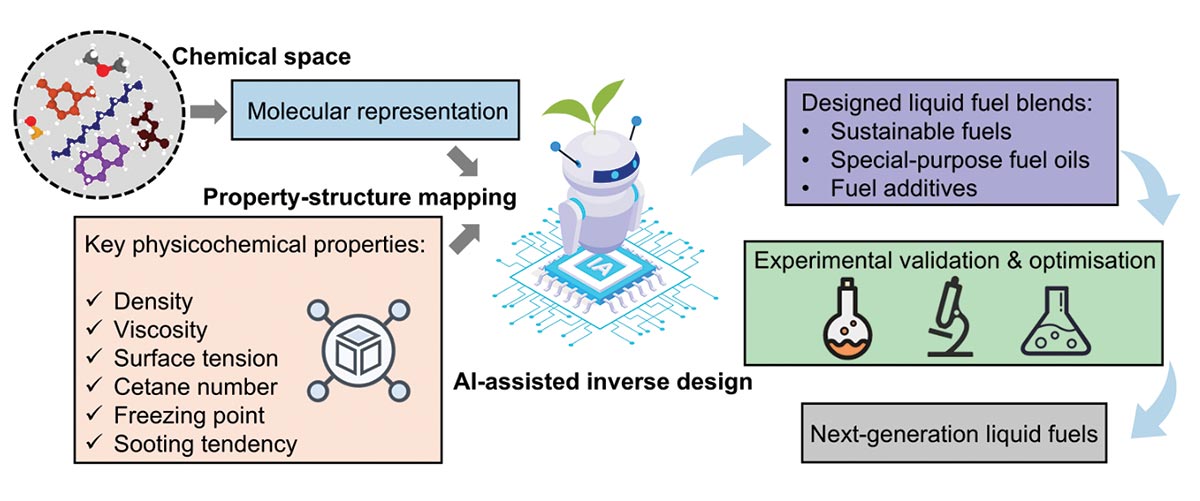
For liquid alternative fuels, there is a lack of “drop-in” fuel that is fully compatible with the existing marine engines and also available at large scales at relatively low costs. However, the recent development in big data analytics provides a possibility to design sustainable liquid fuel blends that can potentially meet the requirements of marine engines. Using deep learning algorithms, a mapping between the fuel composition (including chemical structures) and physicochemical properties can be established. Based on this mapping, an inverse design procedure can then be followed to identify the composition of the fuel blends (Freitas, 2025). Figure 1 indicates the procedures of AI-enabled fuel blend design. For marine engines, there are special requirements for the fuel properties. For example, ISO 8217 for marine application requires a high flash point (marine safety regulations) but presents low ignition quality and more impurities. To design alternative fuel blends for marine engines, some of the available chemicals that can be produced in a renewable way at relatively low costs, e.g., biodiesel, methanol, DME and OMEx, should be examined as potential components for the blends. Although AI-enabled fuel blend design holds the promise for developing “drop-in” alternative fuels for marine engines, further investigation is needed.
Figure 1. Schematic Overview of AI-enabled Liquid Alternative Fuel Blends Design
For gaseous alternative fuels, ammonia combustion or ammonia co-firing with another more reactive fuel (e.g., natural gas including biogas, syngas) represents an effective way of decarbonising marine transport (Xing et al., 2025; Xing et al., 2024; Xing and Jiang, 2024). However, owing to the unique fuel-NOx formation pathways associated with nitrogen-containing fuels, ammonia combustion can generate NOx emissions substantially higher than those from conventional hydrocarbons. More critically, ammonia combustion also produces N2O, a greenhouse gas nearly 300 times more potent than CO2 (Mohammadpour et al., 2022). Therefore, controlling NOx and N2O emissions during ammonia combustion requires urgent attention. To this end, it is essential to investigate the combined application of various pre-combustion and in-situ combustion control strategies, such as slightly rich/ultra-lean combustion, staged combustion, Moderate or Intense Low-Oxygen Dilution (MILD) combustion, plasma-assisted combustion, and porous-medium burners to achieve reduced nitrogen emissions (Zhu et al., 2024). In addition, data-driven optimisation provides new opportunities for designing efficient ammonia-based gaseous fuel combustion systems (Xing et al., 2025) By integrating kinetic modelling, computational fluid dynamics simulation, and AI-assisted surrogate model development, it is possible to efficiently predict key combustion properties and pollutants formation under various operating conditions with high accuracy. Such predictive frameworks enable the tailoring of engine operating modes to achieve an optimal balance between combustion efficiency and the simultaneous minimisation of both carbon and nitrogen emissions.
3.2 The Digital Era: Panoramic Digitalisation for Marine Engines
The digitalisation of marine engines has been developing quickly in recent years, centred around the technology of “digital twin” (Taghavi and Perera, 2024). As a computerised version of marine engine operation for combustion monitoring and prediction, the technology can be used to optimise engine operation to minimise fuel consumption and pollutant emissions including the scenarios of engine transient operation such as fuel switching. Based on real-time data acquisition/processing and engine combustion and pollutant emission predictions, the “digital twin” goes beyond the state-of-the-art PEMS. In addition, it can be underpinned by robust physicochemical models developed from machine learning and big data analytics. Figure 2 shows the marine engine online monitoring and modelling system. The “digital twin” can collect and process data on fuel consumption, engine in-cylinder pressure variation and pollutant emissions, leading to reliable predictions of the marine engine conditions. The implementation of the technology onto marine engines will provide new insight into how digitalisation can improve engine transient operation and impact upon the environmental and economic sustainability of marine transportation when sustainable new fuels are used, addressing the challenge of decarbonisation of marine transport via a panoramic digitalisation. The digital platform (with system diagram shown in Figure 2) will enable a re-imagining and transition of the current shipping for global trading into a digital era with optimal engine operation, enhancing more sustainable fuel / energy utilisation.
Figure 2. Marine Engine Monitoring and Modelling System—the “Digital Twin”
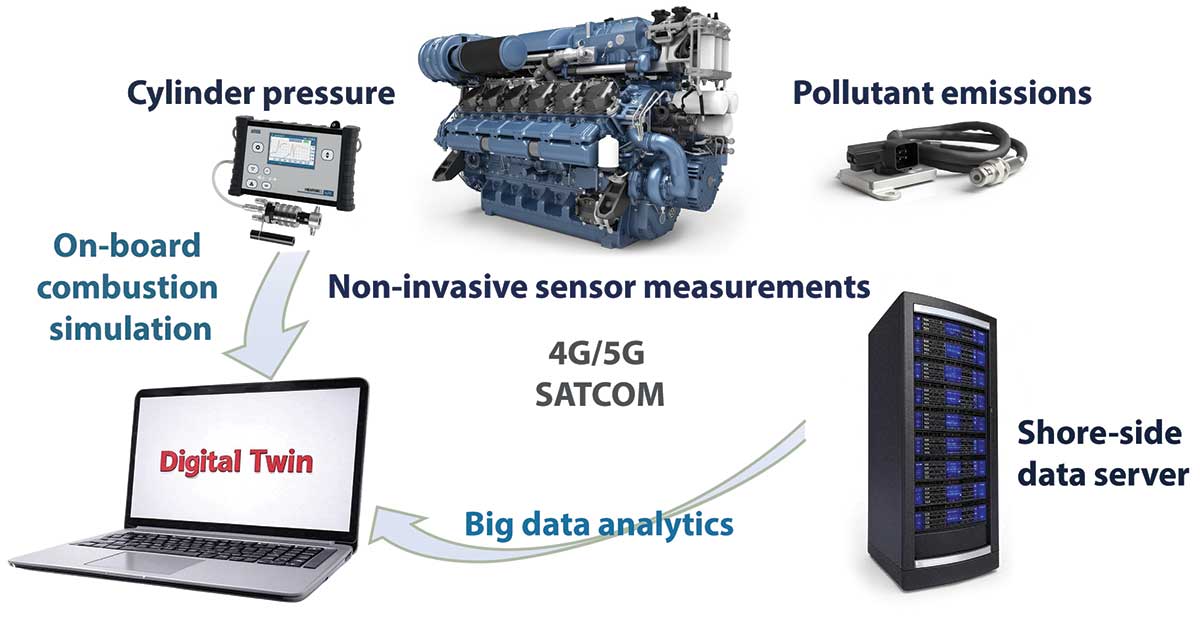
Digitalisation of marine engines will also help condition-based maintenance (CBM), which is widely accepted as having huge potential for cost savings. Through digitalisation, data indicating the health condition of the marine asset such as the engine in-cylinder pressure variation and vibration can be collected and processed in real time. The processed data will be fed back to the “digital twin”, providing a continuous source of reliable information that can be used in many ways: provide CBM optimising maintenance intervals, detect damage ahead of time and improve fuel consumption ensuring compliance with the new strict global emission standards. The monitoring data can also be used to calibrate the “digital twin” modelling/simulation.
In the “digital twin” applications, any abnormal data reading or discrepancy between the measurements and “digital twin” prediction can serve as an early warning to trigger maintenance. The technology can be used to achieve the recovery and prediction of marine engine datasets, and to make use of those in real-time to assist in the management of engine combustion and emissions. The wide adoption of the “digital twin” will lead to stable and continuous service, enabling CBM and constantly optimum engine performance. Big data analytics such as ML can be used to enhance the CBM (Maione et al., 2024), where ML and data-processing algorithms can be employed to process the real-time data collected, to improve the accuracy of predictions, to guide the decision of CBM, and to determine the weights of different input parameters. The ML-based modelling approach will ensure the relatively low cost of the on-board simulation, while the fidelity of the modelling can be guaranteed by the large amount of training data available from the engine pressure and pollutants monitoring and off-line large-scale high-fidelity simulations. The predicted pressure-angle curve and heuristic analysis will provide adjustment recommendations to the ignition angle and alignment of firing pressures across all cylinders. The engine health monitoring module of the “digital twin” will use historical operational data and detect anomalies through an unsupervised machine learning model (auto-encoder).
There is also a key question in marine engine digitalisation: How much can digitalisation play a part in cost-effective decarbonisation before deeper decarbonisation measures are required? The magnitude of decarbonisation that may arise from digitalisation will be compared against other options, including other efficiency measures, propulsion technologies and fuel types. Digitalisation should be considered as complementing other measures of decarbonisation rather than competing. The potential for deeper decarbonisation via combinations of digitalisation and other decarbonisation measures will be vital to achieving net-zero climate goals.
4. Concluding Remarks
To achieve net-zero emissions for marine transport, efficient use of alternative fuels is essential. An effective combination of decarbonisation and digitalisation would enable (near-)zero-emission shipping. Developments in these areas will enable a re-imagining and transition of the current shipping for global trading into a digital era with optimal operations at vessel, fleet, and system levels, enhancing more sustainable fuel/energy utilisation. Furthermore, they will inspire developments of new business models, processes, and policies for future shipping.
Alternative fuels such as synthetic liquid fuels and ammonia will be increasingly used in marine engines. The decarbonisation will be supported by digitalisation, involving technologies such as “digital twin” technology for marine engines, which encompass real-time engine combustion and emission modelling/simulation, artificial intelligence, machine learning, big data analytics, intelligent algorithms, risk-based failure analytics, condition monitoring techniques, and reliability centred maintenance strategies. The combination of decarbonisation and digitalisation encompasses major advantages of data acquisition and utilisation not only for reducing fuel consumption and developing pollutant reduction strategies but also for predictive maintenance.
Decarbonisation and digitalisation will affect the environmental, social and economic sustainability of marine transportation. Further efforts are required on developing deep understandings on the relevant issues, and on developing machine intelligence technologies such as AI-enabled fuel blends design and real-time control of marine engine operation.
- Aakko-Saksa, P. T., Lehtoranta, K., Kuittinen, N., Järvinen, A., Jalkanen, J. P., Johnson, K., Jung, H., Ntziachristos, L., Gagné, S., Takahashi, C., Karjalainen, P., Rönkkö, T., Timonen, H. (2023). Reduction in Greenhouse Gas and Other Emissions from Ship Engines: Current Trends and Future Options. Progress in Energy and Combustion Science, 94: 101055. https://doi.org/10.1016/j.pecs.2022.101055
- Andreae, M. O., Ramanathan, V. (2013). Climate's Dark Forcings. Science, 340: 280–281. https://doi.org/10.1126/science.1235731
- Cooper, D. A., Andreasson, K. (1999). Predictive NOx Emission Monitoring on Board A Passenger Ferry. Atmospheric Environment, 33: 4637–4650. https://doi.org/10.1016/S1352-2310(99)00239-3
- Corbett, J. J., Fischbeck, P. (1997). Emissions from Ships. Science, 278: 823–824. https://doi.org/10.1126/science.278.5339.823
- European Political Strategy Centre. (2019). Clean Transport at Sea: Setting a Course for European Leadership, EPSC Strategic Notes, 32: 1–12.
- Freitas, R. S. M., Xing, Z., Rochinha, F. A., Cracknell, RF., Mira, D., Karimi, N., Jiang, X. (2025). Pathways to Sustainable Fuel Design from A Probabilistic Deep Learning Perspective. Advances in Applied Energy, 19: 100226. https://doi.org/10.1016/j.adapen.2025.100226
- International Labour Organization. (2014). Third IMO Greenhouse Gas Study 2014. London: IMO.
- International Labour Organization. (2020). Fourth IMO Greenhouse Gas Study 2020. London: IMO.
- International Labour Organization. (2025). Draft Revised MARPOL Annex VI (IMO Net-Zero Framework). Circular Letter No. 5005. London: IMO.
- MacFarlane, D. R., Cherepanov, P. V., Choi, J., Suryanto, B. H. R., Hodgetts, R. Y., Bakker, J. M., Vallana, F. M. F., Simonov, A. N. (2020). A Roadmap to the Ammonia Economy. Joule, 4: 1186–1205. https://doi.org/10.1016/j.joule.2020.04.004
- Maione, F., Lino, P., Maione, G., Giannino, G. (2024). A Machine Learning Framework for Condition-based Maintenance of Marine Diesel Engines: A Case Study. Algorithms, 17: 411. https://doi.org/10.3390/a17090411
- Mohammadpour, A., Mazaheri, K., Alipoor, A. (2022). Reaction Zone Characteristics, Thermal Performance and NOx/N2O Emissions Analyses of Ammonia MILD Combustion. International Journal of Hydrogen Energy, 47: 21013–21031. https://doi.org/10.1016/j.ijhydene.2022.04.190
- Schäppi, R., Rutz, D., Dähler, F., Muroyama, A., Haueter, P., Lilliestam, J., Patt, A., Furler, P., Steinfeld, A. (2022). Drop-in Fuels from Sunlight and Air. Nature, 601: 63–68. https://doi.org/10.1038/s41586-021-04174-y
- Si, M., Du, K. (2020). Development of a Predictive Emissions Model Using A Gradient Boosting Machine Learning Method. Environmental Technology & Innovation, 20: 101028. https://doi.org/10.1016/j.eti.2020.101028
- Taghavi, M., Perera, LP. (2024). Advanced Data Cluster Analyses in Digital Twin Development for Marine Engines towards Ship Performance Quantification. Ocean Engineering, 298: 117098. https://doi.org/10.1016/j.oceaneng.2024.117098
- The Royal Society. (2019). Sustainable Synthetic Carbon Based Fuels for Transport: Policy Briefing. London: The Royal Society.
- Xing, Z., Freitas, RSM., Jiang, X. (2024). Neural Network Potential-based Molecular Investigation of Thermal Decomposition Mechanisms of Ethylene and Ammonia. Energy and AI, 18: 100454. https://doi.org/10.1016/j.egyai.2024.100454
- Xing, Z., Freitas, RSM., Jiang, X. (2025). Machine Learning-driven Multi-objective Optimisation of Ammonia Co-firing with Highly Reactive Fuels. Energy Conversion and Management, 341: 120071. https://doi.org/10.1016/j.enconman.2025.120071
- Xing, Z., Jiang, X. (2024). Neural Network Potential-based Molecular Investigation of Pollutant Formation of Ammonia and Ammonia-hydrogen Combustion. Chemical Engineering Journal, 489: 151492. https://doi.org/10.1016/j.cej.2024.151492
- Yang, X., Tsoulakos, N., Xiao, Z., Wei, X., Fu, X., Yan, R. (2025). Estimation of Shipping Emissions from Maritime Big Data: A Comprehensive Review and Prospective. Transportation Research Part E: Logistics and Transportation Review, 202: 104313. https://doi.org/10.1016/j.tre.2025.104313
- Zhu, X., Du, J., Yu, Z., Cheng, Y.-B., Wang, Y. (2024). NOx Emission and Control in Ammonia Combustion: State-of-the-art Review and Future Perspectives, Energy & Fuels, 38: 43–60. https://doi.org/10.1021/acs.energyfuels.3c03104