Outlook on Major Maritime Green Technology Applications in 2026 and Beyond
Bob Li Affiliations & Notes
Editor in Chief of International Ship & Offshore Media China
Correspondence: chinabobli@126.com or china@ishipoffshore.com
The article outlooks the five major maritime green technology application areas in 2026 and beyond. These five application areas are Onboard Carbon Capture and Storage (OCCS), Wind-assisted Propulsion Systems (WAPS), Alternative Fuels, Electrification and Electric Solutions, and Equipment Intelligence.
Keywords :
Maritime Green Technology, Decarbonization, Onboard Carbon Capture and Storage (OCCS), Wind-assisted Propulsion Systems (WAPS), Alternative Fuels, Electrification and Electric Solutions, Equipment Intelligence, Smart Technology
1. Introduction
The maritime industry has been undergoing a rapid technological transformation, especially with green and decarbonization applications as the key driving force behind it.
Major green and clean measures such as ship hull optimization, scrubber, BWTS, vessel efficiency, propulsion improvement, alternative fuels, air lubrication systems, onboard carbon capture and storage (OCCS), wind-assisted propulsion systems (WAPS), energy-saving devices, electrification, equipment intelligence are being employed and pushing the high-end development, even nuclear energy technology is seriously planning in the maritime decarbonization portfolio.
In April 2025, the 83rd session of the Marine Environment Protection Committee of the International Maritime Organization (IMO) proposed a set of measures to drive the decarbonization of global maritime industry, which will definitely shape the maritime development in the journey all the way towards net-emission and net-zero GHG emissions (IMO, 2025).
Based on recent popular conferences, R&D, industry readiness, studies and papers, Shanghai based International Ship & Offshore Media China outlook the five major maritime green technology application area in 2026 and beyond.
2. Onboard Carbon Capture and Storage (OCCS)
Technology group Wärtsilä recently predicted that globally 45% of world ship fleet will still be running on fossil fuel by the year of 2050. This means there be a huge opportunity for adopting onboard carbon capture and storage (OCCS) system in helping achieve the carbon reduction.
Some shipowners and shipyards had successfully tested the installed OCCS system. According to Wärtsilä's tests, the new Carbon Capture Solution (CCS) is proven to reduce vessel CO2 emissions by up to 70 percent, providing shipowners with a solution to meet increasingly stringent environmental regulations. Wärtsilä estimates its CCS would have a carbon capture cost of Eur50-Eur70/mtCO2 ($54-$76/mtCO2), inclusive of capital and operating costs, other suppliers will be nearly the same (Wärtsilä, 2025). The ability to capture CO2 from ship exhaust systems will have a major impact on the industry's efforts to reduce GHG emissions, taking into account the International Maritime Organization's (IMO) 2050 reduction targets.
International Ship & Offshore Media China estimated that the installation wave of OCCS system will be like the scenario of installing scrubber for SOx scrubbing, which appealing to shipowners for achieving the balance between the maritime regulation meets and economic operation (predictive statements reflect the editorial opinions, not definitive future outcomes).
Most OCCS's can be applied to the exhaust from any carbon-based fuel—such as HFO, methanol, LNG and MGO—and is designed to work alongside other emission reduction technologies, including SOx scrubbers, NOx reduction systems, and particulate matter filters.
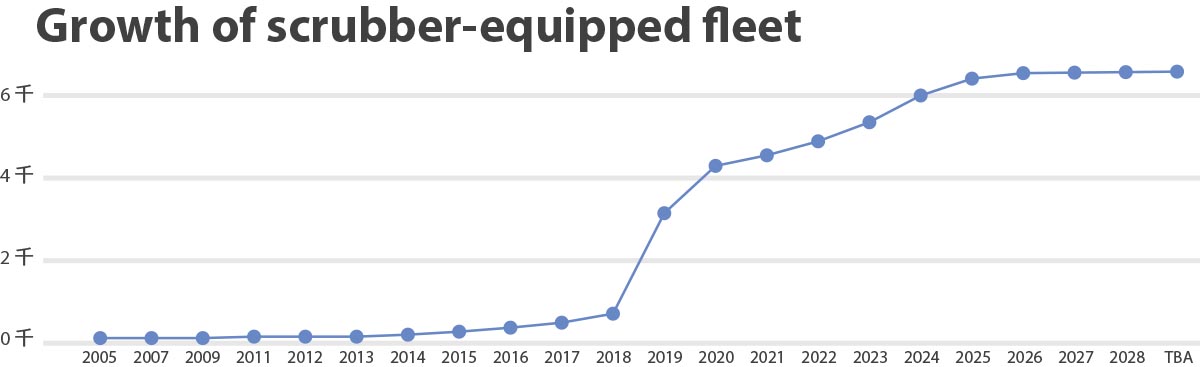
According to the data shown in the DNV chart below, the scrubber installation peak was in 2019, the number reached 3142 ships who burn HFO. This year the scrubber installation will reach 6523 vessels (DNV, 2025).
Figure 1. Growth of Scrubber-equipped Fleet
International Ship & Offshore Media China predicts that OCCS installations could exceed historical scrubber uptake and surpass 10,000 ships under scenarios with stringent Well-To-Wake (WTW) compliance, sustained carbon price signals, and established port CO2 reception networks. This projection is indicative and depends on policy design, financing conditions, available deck/hull space, and verified net WTW benefits. This will be great good news for the marine suppliers and shipyards who will pump in the revenue for the ship new buildings and retrofits.
At MEPC 83, a proposal for a two-tier compliance system was tabled:
- Direct compliance–strict and which essentially introduces a minor levy
- Base target–roughly in line with FuelEU Maritime
The system also includes the Remedial Units (RUs) prices which is similar to the FuelEU's penalty. The initial price for RUs has been set at US$100 per tonne CO2 equivalent for Tier 1 emissions and US$380 per tonne for Tier 2 emissions.
If adopted, entry into force could occur no earlier than 2027, with compliance envisaged from 2028. A few procedural technicalities remain but the direction is clear. The proposal includes WTW accounting and a mechanism for transferring or banking surplus compliance units within specified limits. Readers should consult the final IMO resolution text once available for definitive provisions.
3. Wind-assisted Propulsion Systems (WAPS)
Wind-assisted Propulsion Systems (WAPS), such as rotor-, suction-, wing- and soft sails, as well as kites, are gaining renewed attention as the shipping industry is facing increasingly stringent greenhouse gas (GHG) emission regulations to support net-zero emissions by 2050.
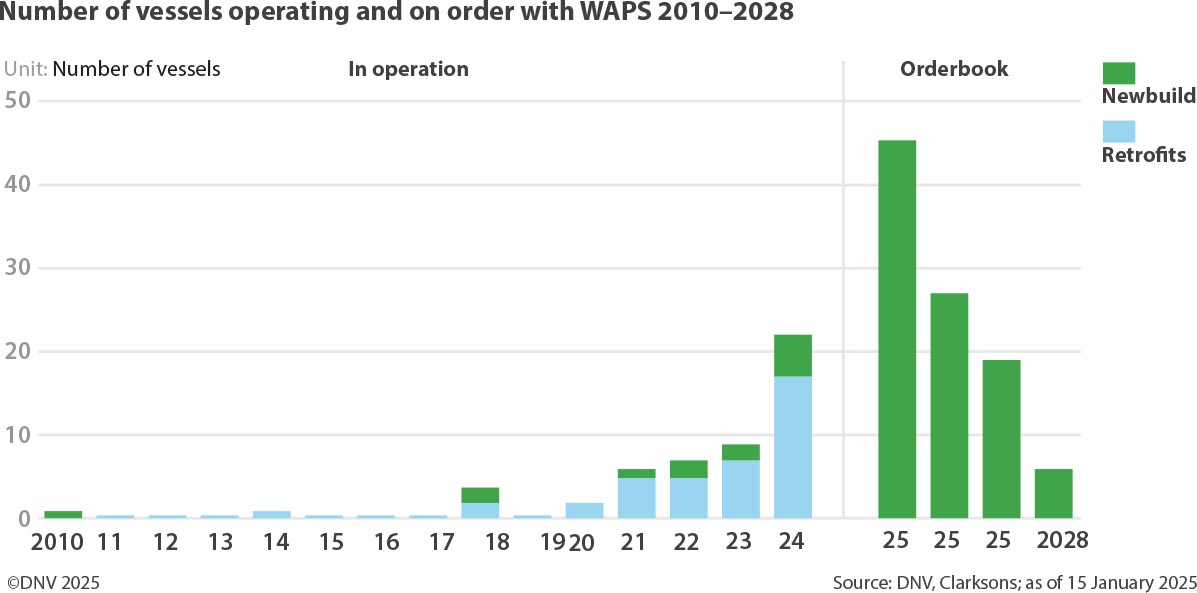
DNV in a report stated that there has been a rapid uptake of WAPS in the global fleet since 2021, with 52 seagoing ships now in operation and 97 newbuilds with WAPS of January 2025 (DNV, 2025).
Figure 2. Number of Vessels Operating and on Order with WAPS 2010–2028
China Merchant Energy Shipping Co., Ltd (CMES) built a very large crude carrier (VLCC) fitted with fuel-saving and emissions-reducing wing sails in 2022. Being equipped with two pairs of new generation rigid wing sails made of carbon fiber composite, which will provide auxiliary propulsion power to help reduce the vessel's fuel consumption and emissions. The raised sail has a height of 40 meters, and total area of a single sail surface is about 1,200 square meters. The sails will help allow the vessel to burn about 9.8% less fuel on average, which corresponds to CO2 emissions reduction over 2,900 tons on a Middle East to Far East route (CMES, 2022. Results mentioned in the report depend on route-specific wind conditions, speed policy, and concurrent operational measures; multiyear averages may vary).
4. Alternative Fuels
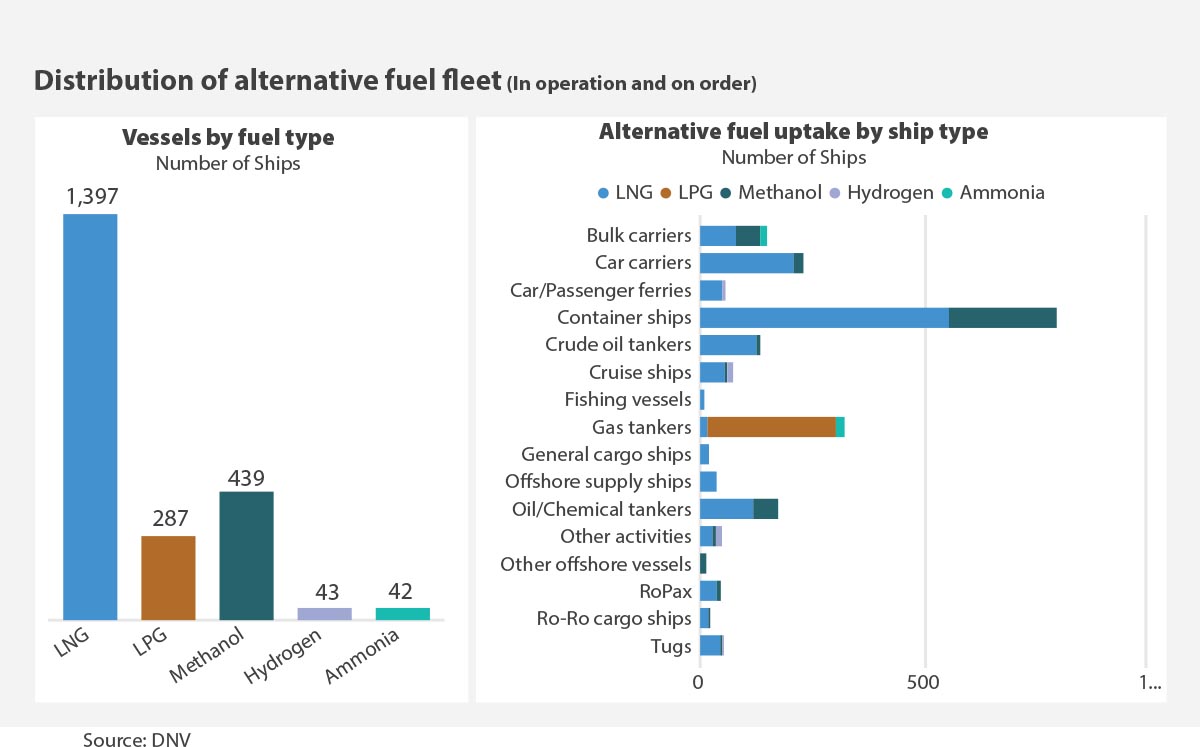
350 million tonnes of fuel oil currently burned by ships each year, the global shipping industry requires significant investment in technology and alternative fuels to achieve a net-zero transformation and drive sector-wide change. In response to the International Maritime Organization a set of measures to drive the decarbonization of global shipping, during the first half of 2025, 183 orders for new alternative fuel-capable vessels were reported, accounting for 55% of the capacity of contracted vessel.
DNV reported that a total of 28 new orders for alternative-fueled vessels were placed in July 2025, AFI's latest report has revealed. LNG remains the dominant fuel choice, accounting for 22 of 28 new orders. The majority of these orders were concentrated in the container segment with 19 on record, with the two remaining being tankers and one a research vessel. Methanol followed with three new orders, including two bulk carriers and one offshore vessel. July also saw two ammonia-fueled gas carriers ordered, and for the first time, one ammonia bunker vessel was added to the orderbook (The Maritime Executive, 2025).
Figure 3. Distribution of Alternative Fuel Fleet (In Operation and on Order)
On August 7, Italian shipping firm Grimaldi Group's has welcomed the second ammonia-ready Pure Car and Truck Carrier (PCTC), Grande Tianjin, from Shanghai Waigaoqiao Shipbuilding (SWS). The Grande Tianjin is compatible with electric vehicles, conventional fuel cars, and heavy RoRo cargo (MarineLink, 2025).
Equipped with a new low-consumption main engine, integrated energy-saving devices (twisted rudder, rudder bulb with fins), and a medium-voltage shore power system enabling zero emissions while berthed, it significantly reduces energy consumption. It also holds RINA's Ammonia Ready certification, enabling future conversion for zero-carbon fuels.
In July 2025, the Grimaldi Group held the naming ceremony for the Grande Shanghai, the first of ten next-generation Pure Car & Truck Carrier (PCTC) vessels commissioned from China Merchants Heavy Industries (MarineLink, 2025).
5. Electrification and Electric Solutions (Hybrid, Shore Power, Shaft Generators)
Electric solutions are a growing part of maritime decarbonization today, virtually every segment of the commercial maritime industry is exploring hybrid and electric options, Applications span from ferries and tug vessels to containerships and defense area.
Electrification is not only applied mainly in inland, nearshore shipping as before. Hybrid systems, which combine traditional diesel engines with electric motors and battery storage, are now common across a range of vessels. Even larger oceangoing ships—historically considered too energy-intensive—are integrating Power Take-in (PTI) and Power Take-off (PTO) systems, making space for energy storage solutions and incremental decarbonization.
Figure 4. Battery Ships by Ship Type
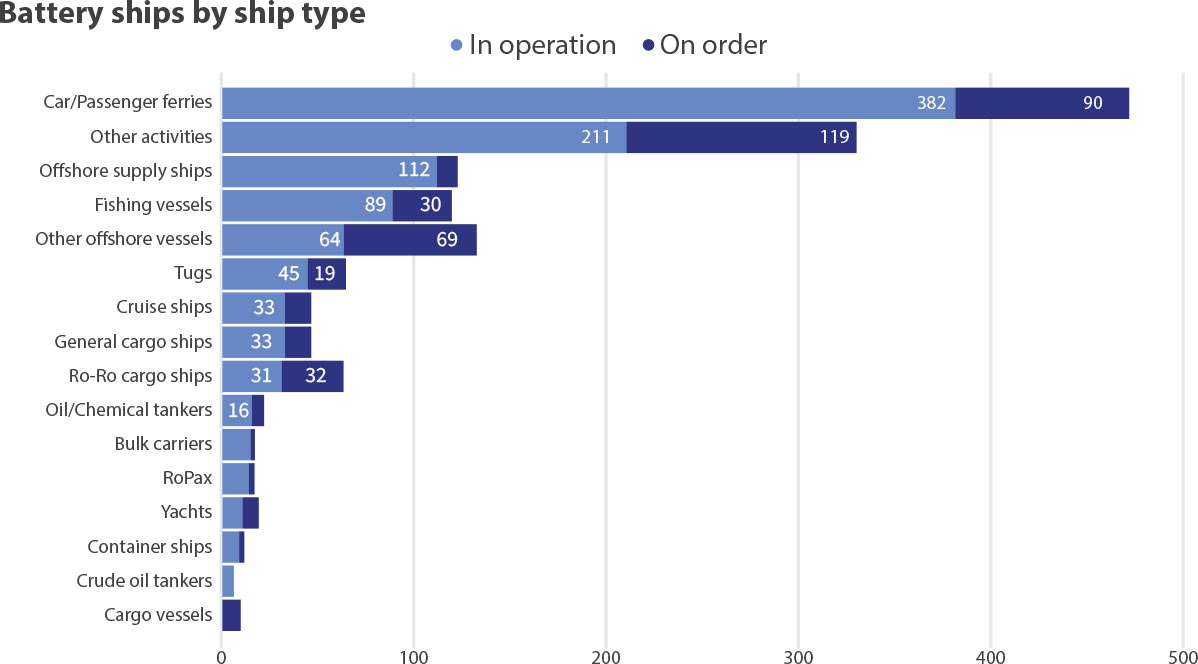
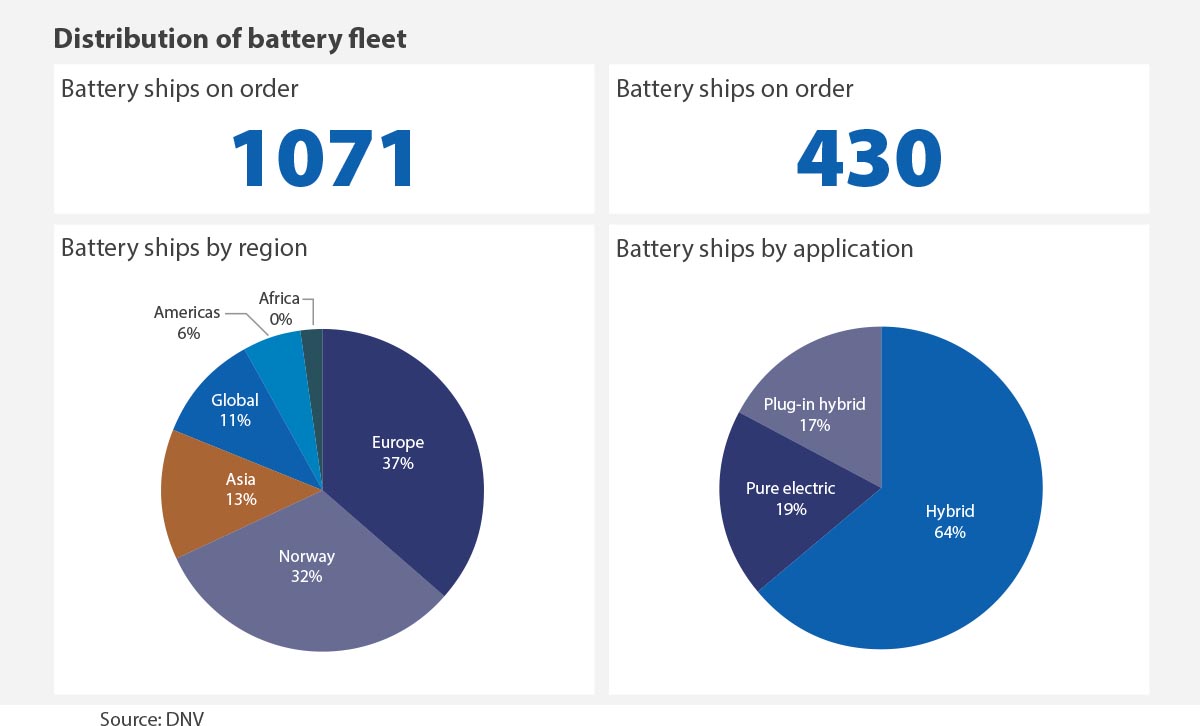
Figure 5. Distribution of Battery Fleet
In August 2025, ABS issued a New Technology Qualification certificate to shipyards for their next-generation electric propulsion solution—the Medium Voltage Direct Current (MVDC) power system for ships. The Breakerless-MVDC Power System builds on shipyard modular propulsion drive system and is the first in the world to receive an ABS NTQ certificate, indicating the technology's feasibility and maturity through a systematic evaluation program (ABS, 2015).
6. Equipment Intelligence
Due to technological development and ship's intelligence application, growing automation of components and systems onboard is bringing about a rise in equipment intelligence.
Major equipment as engine/power system, bridge control, piping system, deck machines, scrubber, BWTS, vessel efficiency, propulsion improvement, alternative fuels supply, air lubrication systems, onboard carbon capture and storage (OCCS), wind-assisted propulsion system (WAPS), energy-saving devices, electrification and others have been enabled growing intelligence elements and become more advanced and efficient.
In order to support more complex and challenging operation in shipping, particularly, with the maritime industry accelerating its shift to further decarbonization and digitalization, more advanced intelligent equipment will be introduced and employed.
ABS said that given the rapid rise of digital technologies, connectivity and data processing, smart (intelligence) technology is becoming increasingly more common in the marine and offshore industries.
7. Conclusion
Smart technology helps to effectively collect, manage and process operational data, as well as perform advanced data analytics, enabling data-driven decision making. These smart functions help owners and operators more proactively manage the health and performance state of their assets as well as assist the crew in performing their day-to-day work and reporting activities.
Smart technology will be a key factor for industry sustainability moving forward. Future adoption of smart technology will coincide with quickly changing environmental regulations. Advanced monitoring and data analysis, as well as asset performance optimization, will be crucial for environmental compliance moving forward. As we approach 2030 and beyond, smart technologies and how a vessel's data are utilized to optimize performance are going to be critical to meet the reduced carbon requirements being developed by the IMO.
It is expected that with more intelligent equipment application, in near future, many ships will be intelligent enough to operate and manage on-line all the time, both in vessel-based and land-based scenarios. By 2026–2030, adoption will likely follow a measures-first trajectory: wind-assist and digital optimization on suitable routes, hybridization and shore power where feasible, and selective OCCS pilots where port CO2 logistics emerge. Alternative-fuel-ready platforms (e.g., methanol- or ammoniaready) offer flexibility as supply chains mature. Smart technology (advanced monitoring, AI-enabled control) underpins these steps by sustaining measurable, verifiable efficiency gains and compliance reporting.
- ABS. (2025, August 7). Breakthrough Electric Propulsion Technology for Maritime Industry Earns ABS Certification. https://news.cision.com/american-bureau-of-shipping/r/breakthrough-electric-propulsion-technology-for-maritime-industry-earns-abs-certification,c4215653
- China Merchant Energy Shipping Co., Ltd. (2022, September 25). Celebrate the 150th Anniversary of China Merchants丨Commemorate Aden and Name New Aden. https://www.cmenergyshipping.com/post.php?p=1396&c=cmes
- DNV. (2025). Maritime Forecast to 2050. https://www.dnv.com/maritime/maritime-forecast/
- International Maritime Organization. (2025). Marine Environment Protection Committee (MEPC 83), 7 to 11 April 2025. https://www.imo.org/en/mediacentre/meetingsummaries/pages/mepc-83rd-session.aspx
- MarineLink. (2025, July 21). Grimaldi Names First Ammonia-Ready Car Carrier. Marin News Magazine. https://www.marinelink.com/news/grimaldi-names-first-ammoniaready-car-528166
- MarineLink. (2025, August 8). Grimaldi Takes Delivery of Second Ammonia-Ready Car Carrier. Marin News Magazine. https://www.marinelink.com/news/grimaldi-takes-delivery-second-528808
- Wärtsilä. (2025). Onboard Carbon Capture and Storage: Pioneering Solution for Ships. https://wartsi.ly/44hAY7l
- The Maritime Executive. (2025, August 2). DNV's Alternative Fuel Vessel Order Figures for July 2025. https://maritimeexecutive.com/corporate/dnv-s-alternative-fuel-vesselorder-figures-for-july-2025
- Wärtsilä. (2025, May 7). Wärtsilä Launches Carbon Capture Solution to Shipping Market after World-first Full-scale Installation Success. https://www.wartsila.com/media/news/07-05-2025-wartsila-launches-carbon-capturesolution-to-shipping-market-after-world-first-full-scaleinstallation-success-3582634